we had one too. last year the big old tree at the end of our driveway had one. a big-ole-mushroom-fungus. inordinately weird and begging you to touch-it-ewww-don’t-touch-it.
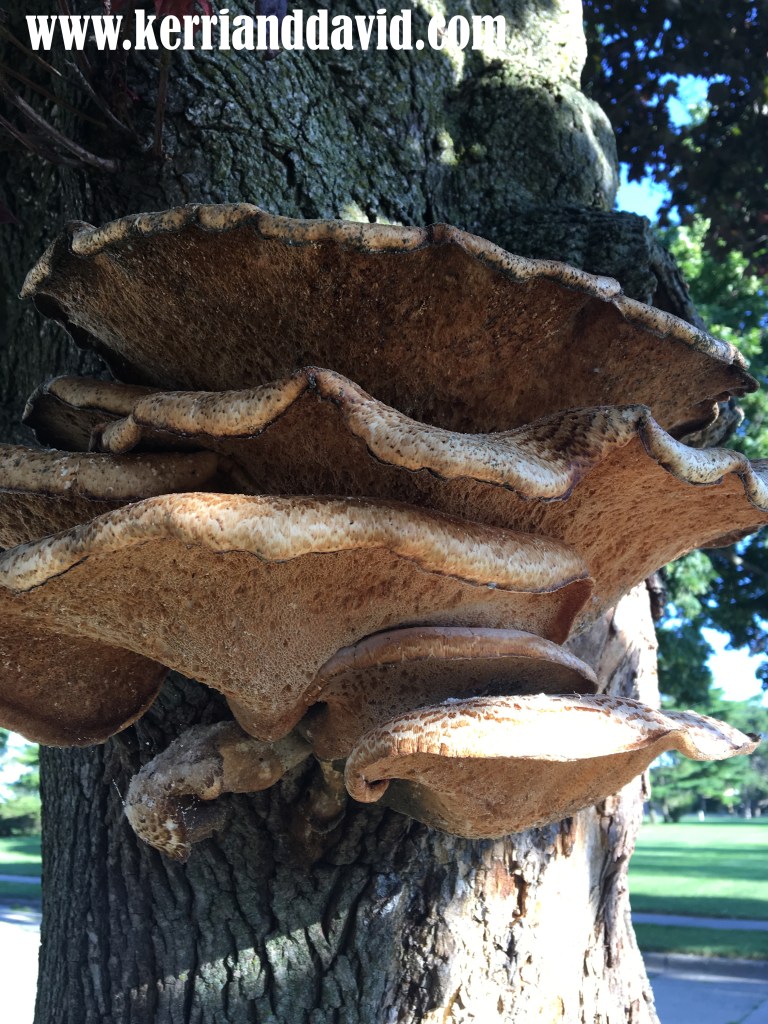
this one – on a big tree by the park a few blocks away – looked like shelf fungi. shelf fungi is a wood rotter, damaging to trees. we think ours was a northern tooth fungus (who knew there were so many tree-shrooms!); the tooth fungus can impair the structural stability of our tree. and, i read, fungi breaks down dead wood, thus a part of the forest ecosystem. trying to remove it will release billions of spores that can infect other trees and plants. just makes you wanna shudder.
it seems somewhat unfair that as these giants age they become more and more susceptible to these fungus matters. it would seem like the gentle giants had earned a peaceful coast into the sunset, surviving youth of sapling, the perils and storms of young adulthood, the strength and steadfastness of middle age, the passing-of-the-baton to the golden years. it would seem that these mighty towers of thousands upon thousands upon thousands of days of stories should be granted ease, sunlight, water, serenity.
so why is it that they are not impervious to challenging diseases, exhaustion, lack of nutrients, even rot?
is their medicare and social security also at risk?
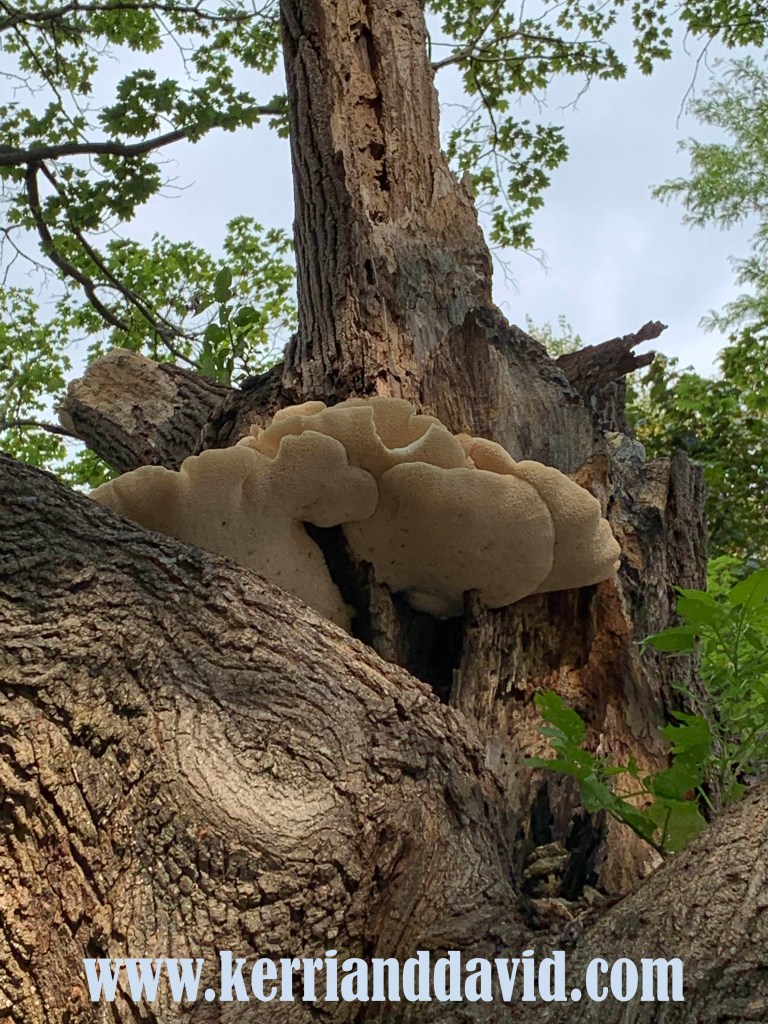
the amazon truck pulled up and the driver got out, ran a package to our door and ran back to the truck. but he didn’t pull away. he pulled up a bit and stepped out again with his phone, aiming it up at the big old tree at the end of our driveway. in the notch of branches was a giant mushroom, super-sized by humidity. he poked at it and a chunk fell off for him to investigate. from inside i couldn’t tell what he was doing, but once i walked down the driveway i could see the giant ‘shroom. perhaps a northern tooth fungus, it was beautiful and mysterious. it’s no wonder the amazon guy stopped to stare and photograph it.
there are years that we have had mushroom rings in our yard. you’re thinking, wow, they mustn’t have great grass. no, we don’t have great grass. but a fairy ring of mushrooms is common and apparently take about a year to form, all underground. superstition says that if you enter a fairy ring, you will dance with nature’s creatures and you will be unable to stop. since we like snacks and sleep, we have chosen not to enter the ring, avoiding the off-chance that this inexorable dancing take over. but the presence of fairies and elves seems magical and since these rings are associated with luck, i choose good luck over bad and we haven’t done anything to prevent them from being there.
one evening as we sat having a late dinner at our covid table in the sunroom, happy lights on and a couple candles flickering, i looked more closely at snakeinthegrass. i was surprised to find the presence of tiny mushrooms, sprouting up and living in community with this sansevieria plant. perfect little fungi, they stood tall and steadfast for a few days and i imagined tiny invisible-to-the-human-eye fairies waltzing under their domes. we laughed at the ballroom on our table.
as fascinating as mushrooms are, i would never be one to go out into the woods to arbitrarily pick them; there are too many doppelgangers out there and we are not informed. but in the way of learning new factoids, it’s amazing to note that mushrooms actually breathe oxygen – just like humans – and emit carbon dioxide, the opposite of plants. and the genetic makeup, the actual dna, of mushrooms is more similar to humans than plants.
as i look at the coming and going of these tiny mushrooms in our potted plants and high in our maple tree and ringing in the yard, i think about the necessity of their existence in our ecosystem. fungus, they give back and make it possible for plants to survive. they are synergetic without exception. perhaps their dna is even more advanced than humans.





 reverse threading