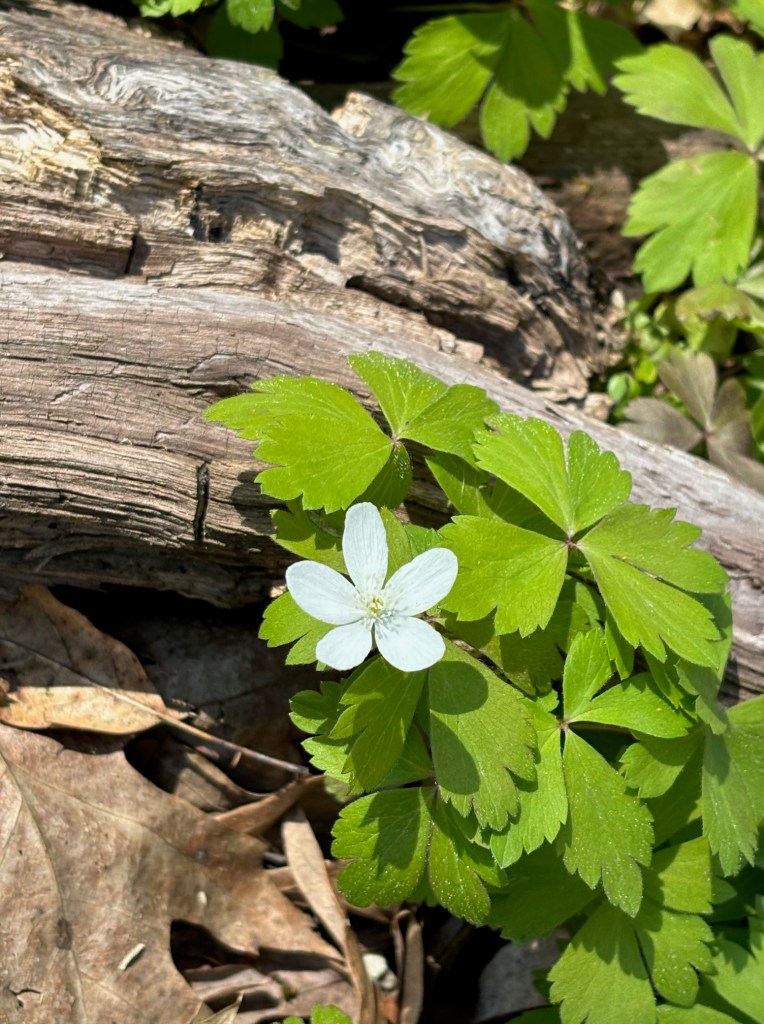
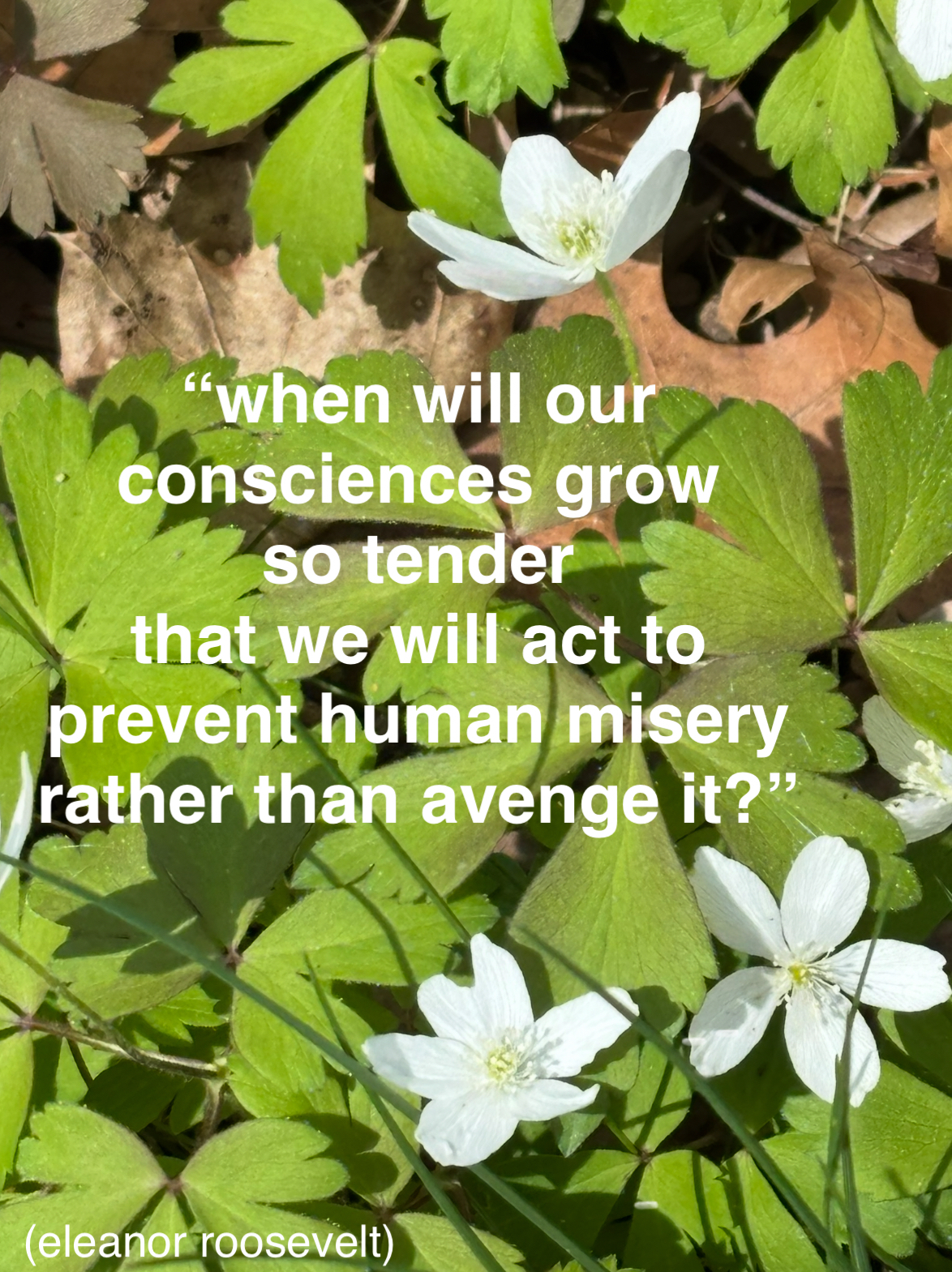
the wood anemone is a “spring ephemeral“. the plant “dies back to the ground by mid-summer“. there is not a lot of time to be as delicately beautiful as anemone is.
so the anemone put on a fine show in their months of prime, the only months their performance is open. they waste no time fussing around, angsting over the circumstance of their sprouting – their place of origin, no time arranging every single thing to their benefit so as to live a grand life in the months of their lives.
instead, they shine. they grow – in community with every other plant and fungi, in and amongst the trees, fallen logs and dried leaves. they unfurl their five or six petals, their leaf whorl fragile, trembling in the breezes – this “wind flower” is standing vigil for spring.
they make the best of it.
and when their turn is done – when it is time for their last bow, their last quake in the wind, their petals slowly dropping one by one, their stamen no longer sheltering seed, their stalks withering with the sun – they quietly take leave and return to the ground to wait – for next spring.
anemone don’t wonder about their ascendancy, their import, their legacy. they do what it is they are here to do – providing early season nectar for pollinators, preventing erosion by retaining soil moisture.
their herald of spring, their succumb to summer’s hot sun – part of the greater plan. their job fits right in symbiotically with the rest. they do not abdicate to other wildflowers what is theirs to do; neither do they overreach, trouncing all the other wildflowers in their midst.
they are what adults should be. adult humans, that is.
were i to be on jeopardy – and were there to be a topic called “agriculture” – and were i forced to try and answer any question at all – $1000, $800, $600, $400 or even $200 – i would fail miserably. the tools of the trade are foreign to me, just as, i suppose, sheet music for the rachmaninoff piano concerto no.2 in c minor might befor the farmer skilled at using the farm implements. different languages entirely.
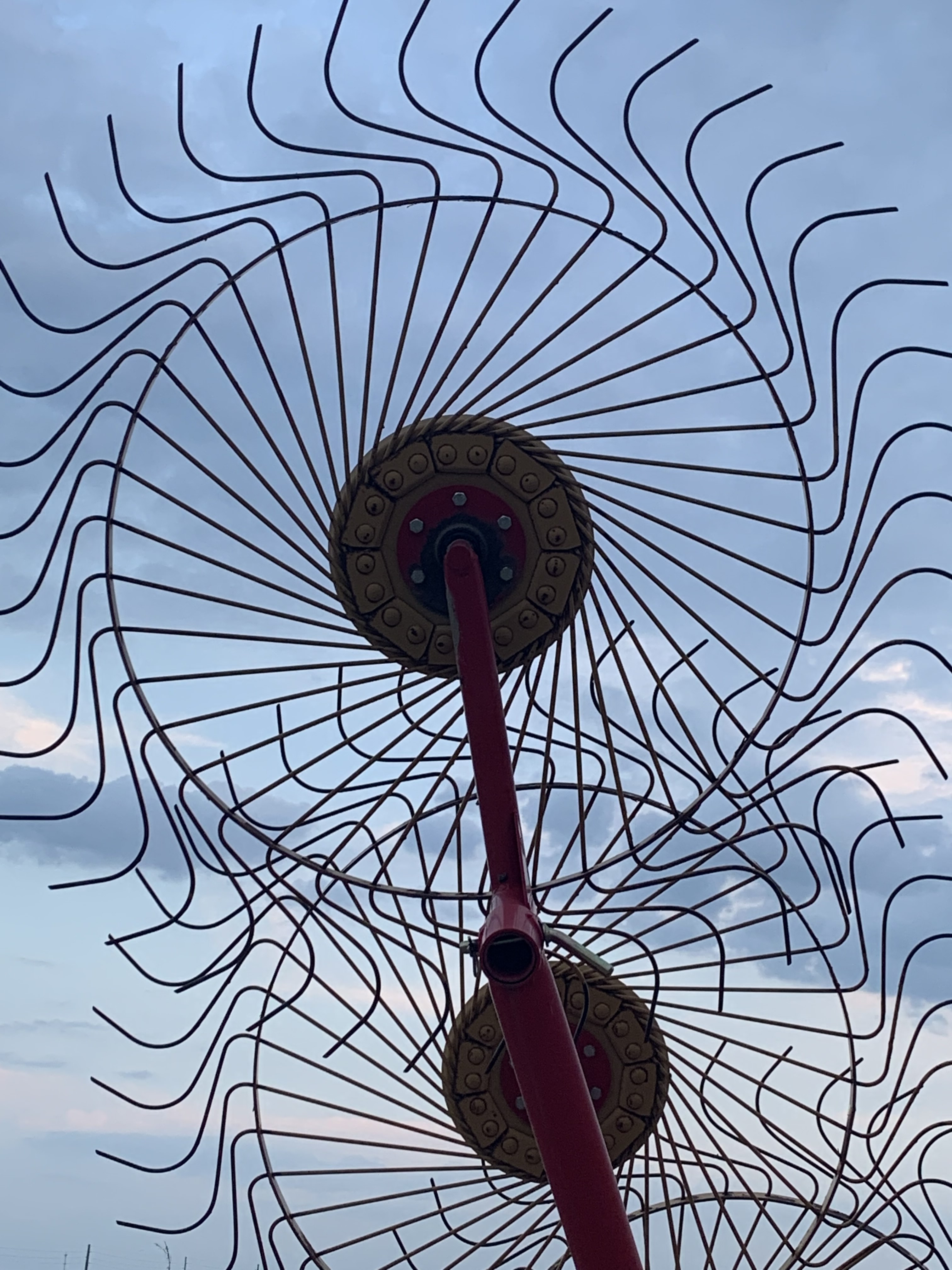
so, for us, sitting outside the iowa farmhouse, gazing around at the unfamiliar, it was both mysterious and magical. interesting textures and things with wheels had us guessing and googling. everything begged to be photographed. for us, the unfamiliar is novel and, through our eyes, doesn’t represent the hard work it actually stands for. instead, the wheel hay rake is flowers in the sky, metal petals reaching out from the center on thick metal stems connecting to the machine. the tractors and disc cultivators and harrows and silos – all unknown and a little exotic. it is easier to see beauty in that which is simply shape and texture than when it is the embodiment of the toil and worry each farmer faces each and every year.
i suppose that should make it easier for me to understand why others can generously send notes and email messages to me about my music, about how the piano piece or a song resonates with them, yet i – at this moment in time – see toil and worry. worry about how – in a new world – to put out new music. worry about how to sustain it all financially. worry about how – with a significantly-reduced wrist – my music may differ from what it has been. new crops, new agricultural costs, new limitations. what is that expression about perception? one man’s trash is another man’s treasure. that might be true also as – one man’s albatross is another man’s beauty.
yet, despite the decidedly different ways we perceive things out of our realm of familiarity, we are all spokes in the big wheel. we honor all the tools of our different trades, the languages, the expressions of work, the products of toil.
to be fascinated by another’s work is to appreciate it. to appreciate another’s work is to respect it. to respect another is to live together, under one sun … flowers in the sky.
*****
on this two artists tuesday, we’d like to make a clarification. i received a text asking me about what “buy me a coffee” meant. just as i was given to misunderstand this platform, i’m not sure we have done an adequate job of explaining it. so, please forgive any redundancy as i take a moment to clarify:
the arts don’t generally have the same avenues for payment as other professional routes, so there has been an effort for more crowdfunding types of options. both BuyMeACoffee and Patreon are platforms in which content creators can receive support from people who appreciate their work.
http://www.buymeacoffee.com is a casual way to support creators. when you “buy a cup of coffee” it transfers $5 per “cup” (minus a small percentage) directly to an account for the artist you have chosen to support. it is called a virtual tip jar because it is not a recurring payment – it is a one-time tip for something that has resonated with you. you can opt for 1, 3, 5 “cups of coffee” or any number you wish (in the square box) and the application will do the math. when i first encountered it on a site of wonderful thru-hikers we follow, i mistakenly thought it literally was sending them coffee – or – sending them money they needed to use for coffee-and-only-coffee. silly me. it is simply providing helpful funding – a lovely way for us to tell them “thank you” for inspiring us. a “cup of coffee” is a way to support them in any number of five dollar increments.
patreon (which we will have shortly) is an opportunity to subscribe to an artist’s work on a monthly, recurring basis. people who wish to support the arts have an ongoing and dedicated way to do this through patreon, choosing a monthly dollar amount. again, a small percentage is taken out and the rest is made available to your chosen artist(s).
either way, artists everywhere appreciate the generosity of those who take the time and the resources to help them keep doing their work in the world. all spokes in the big wheel.
that gratitude goes for us as well. we appreciate you and are grateful for your support of our work. you are flowers in our sky.




 reverse threading