it is our meditation, our respite, our rejuvenation, to hike. so we find trails everywhere we go. our old hiking boots have stories of mountains and deserts, forests and rivers, dunes and sidewalks.
we choose to trek instead of anything else. for we have found that “in every walk with nature, one receives far more than one seeks.” (john muir, naturalist)
in these times of pandemic, our travel has been of limited scope. we have taken seriously the words of fervent scientists and medical experts to stay close to home, to wear masks, to social distance, to be always aware of putting self and others at risk. and so our spectrum of hiking trails has been reduced in range, the radius from our home none too large.
the river we hike along is well-known to us now. we know the curves in the trail; we know the bend in the river and where the water laps at the bank. we anticipate the small turtles on the rock in the tributary; we expect the butterflies to be numerous as we pass the field of wildflowers. we know where the mile markers are before we see them. we know where the mosquitoes will swarm. it doesn’t change anything for us. we still go. we still hike. for “into the forest i go to lose my mind and find my soul.” (john muir)
each time we start we are aware of how very familiar this place is. each time we finish we are aware of seeing it with fresh eyes. marcel proust’s words, “the real act of discovery consists not in finding new lands but in seeing with new eyes” comes to life with every booted step.
the place we go, the haven we seek, are trails that let us be quiet, trails that let us talk, trails that make us tired, trails that invigorate us. they need not be new.
each time we take any of our beloved trails or walks in the general radius of our sweet home we breathe air into anxious hearts, solace into worried minds, we stretch stress-tensed bodies, we are mindful of glimpses of eased souls, we draw inspiration from this good earth, we find the new in old.
i still have it. the index card is taped to the inside bottom of my old piano bench down in the basement. these words, “perfection is an eight letter word. practice ” written in eight-year-old pencil-printing. it’s been there – in that old spinet piano bench – since 1967, when i started taking lessons and needed a reminder how to keep the ups and downs in perspective.
i spent long hours on that bench and on the organ bench also in my growing-up living room. what i could hear in my imagination wasn’t necessarily what was showing up on the keys. my sweet poppo would encourage me, “remember, practice makes perfect,” he’d say. i’d add, well, at least practice moves you in that direction.
there’s no guarantee for perfect. there’s no route to it and any expectation that you will achieve it really is for naught. the best you can do is the best you can do – moment by moment. with practice, each best-you-can-do is better than the last. and so on and so on.
it’s the caring that matters.
i have two amazing children who have shown me examples of the pursuit of how to do something, to a point of excellence, that you’ve never done before. the keeping-at-it, toughlove-letting-go-of-judgment, the training, the practice, the trying-failing-rinse-repeat-ness of learning. they approach new things like stoic explorers, adventurers prepared and open to experience.
it’s the very thing that inspired our snowboarding lesson earlier this year – the one where i broke both of my wrists. every time i hear someone say, “eh, i’m too old; i can’t learn that,” i store my emotional response to that statement away in my memory bank, waiting for the day i’m about to say just that so i might pummel the words before they escape my lips.
even though my wrists broke and even though i cannot point to any great accomplishment or success on the slope, i would not take back the experience or the exhilaration and anticipation of learning something new, particularly, in this case, that very thing that would give me the slightest first-hand touch, not merely a window, into my daughter’s professional world.
in post-cast moments many people, aghast, said to me, “what were you thinking? don’t you think there’s a point you are too old for that? remember your age!” i am more aghast at these words than all the months dealing with uncooperative wrists in a livelihood where they really matter.
knowing first-hand how difficult and humbling pure novice-ness is, i hope i can always release the suffocating self-evaluating that goes hand-in-hand with being new at something; i hope that i always care about learning.
at eight i had no idea what piano lessons would mean to my life. i simply wanted – really, really wanted – to learn. i, at 8, didn’t beat myself up over getting it wrong or failing nor did i get self-conscious about my journey of mastery. i just stepped into it. and i cared with all of my eight-year-old heart.
we walk and talk about the day The Girl or The Boy suggest to getting-older-every-day-us that we purchase new technology or download a new app or try a new recipe or consider a new lifestyle or or or …. the day we will want to say, “eh, we’re too old; we can’t learn that.” i look down at my wrists and i remember to care.
summer is soon going to draw to a close. it’s august 10 and with today’s feel-like at 96, it’s clearly not anytime too soon. but soon enough.
this summer has been unlike any other. in our deference to the pandemic we have limited ourselves to that which we believe shows regard to recommendations given so as not to be responsible for spreading this. we’ve worn masks. we’ve social distanced. we’ve not eaten in restaurants or stood by barstools sipping wine in enclosed spaces. we haven’t shopped in department stores or had people over in our home, and, differing from every other summer we have had together, we haven’t traveled. it has been unlike any other.
but that isn’t the case for everyone. people have flocked to the beaches and water parks. people have traveled to hot spots – on purpose, in the name of looking for a break. people are eating in restaurants and are gathered at bars and at big backyard barbecues. people are singing in indoor venues and are clustered on sandbars. people have gone to little towns, vacationing and, with the it-won’t-happen-to-us mindset, placing the locale at risk, placing the locals and the health care system in that locale in a precarious way. hundreds of thousands of people are headed to or are gathered in sturgis right now. it’s their summer. and, if you scroll through facebook, it’s not a heck of a lot different than their last summer.
i read a quote today that spoke to the sturgis crowds. “there are people throughout america who have been locked up for months and months,” was the excuse for an influx into this town of 7000. i have to disagree. any instagram or facebook peek will reveal that people are not locked up; many people have lived summer just like they always live summer: any way they want.
in the attention-deficit way of america, many people have simply moved on and their temporarily-outward-gaze has shift-key-shifted selfishly inward. but we are still out here: mask-wearers, social-distancers, stay-close-to-homers, quietly and not-so-quietly trying to mitigate this time. and we can see the others so we are disappointed, saddened and stressed and we are riding the long-limbo-wave of impossible decision-making.
the masses have spoken – at least in this country – and freedom (read: independence from the government mandating for the safety of all) rules.
but freedom isn’t free, as the old up with people song points out, “freedom isn’t free. you’ve got to pay the price, you’ve got to sacrifice, for your liberty.”
i suppose that our sacrifices count, little as that might be in the big picture. as this pandemic continues to rage, as chaos continues to ensue, as relationships shatter over disease-disagreement, our not going to wine-knot matters, our crossing-the-road-to-the-other-sidewalk counts, our consistent mask-wearing-social-distancing makes a difference. it just doesn’t feel that way. the bigger picture looks bleak and my heart sinks looking ahead, fall and winter just over the we-have-so-many-unanswered-questions horizon. whether they (in a countrywide sense) are exercising caution or not, our little part is significant.
the up with people song continues, “but for every man freedom’s the eternal quest. you’re free to give humanity your very best.”
what is our very best? individually? collectively?
As FACEBOOK continues to block my blog from posting, please consider following this blog. There is a button on this page that will subscribe you. Of course, you are free to unfollow at any time. Thank you for your consideration and for reading. xo
i was trying to catch up my calendar – the dollar version – where i write things we’ve done, thoughts, ideas, hikes. on new year’s day i usually take out the calendar and read the whole thing, a review of the year, so to speak. post-broken-wrists, not being able to write with my right hand, i kept my calendar on the computer. somewhere along the way i stopped jotting things down.
now, with pencil in hand, i am trying to catch up. not only is that impossible, but it’s shocking to see the story-arc of the year. time flies. it occurred to me this morning that on new year’s day 2021 i will likely look back and see a year with a vast there-wasn’t-much-we-could-do theme. it’s consistent. the pandemic has altered the freedom of moving-at-will, the freedom of easily-gathering-together, the freedom of travel, of ranging around, and any real normal-summer adventures. a time that, painfully, just isn’t the same as all other summers. it doesn’t feel the same; it doesn’t look the same. it doesn’t live the same way. the impotent months, a time of self-sacrifice-for-the-whole, would seem like a common story for all.
only it’s not.
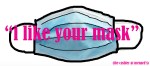
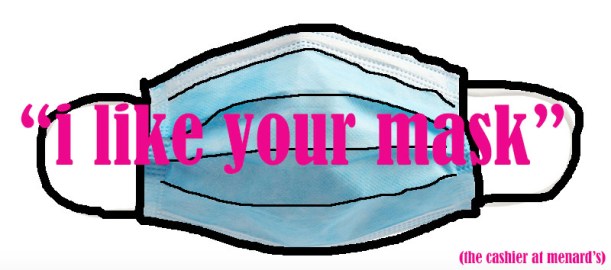
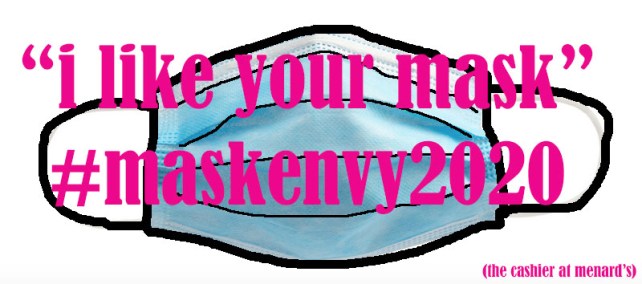
“i like your mask,” commented the cashier at the home improvement store. things you never thought you would hear. our masks are all handsewn; a variety of fabrics, after washing they hang on a hook on the refrigerator, ready. her mask was solid black and so i, in we-wear-black-all-the-time predictability, actually liked hers. “what am i doing?” i wondered. we are comparing masks. MASKS. surely this will go down as a 2020 commonality for people.
only it won’t.
with windows open allowing in the moist rain-cooled air of the night, over coffee this morning we talked about common narratives. it would seem that, of all years, of all times past and, hopefully, times to come, this year would have the most common narrative for all people. parallel experiences, somewhat indistinguishable in the limitations of a global pandemic, a time of everyone-coming-together, a time of doing-the-right-thing, a time of protecting-each-other, a time of relinquishing selfishness and adopting consideration, even altruism, a time of caring. to everything there is a season. a season of commonality.
only that’s not the case.
instead, any perusal through social media will show you that summer is summer and americans are out and about. according to AAA, nearly 700 million people will take roadtrips this summer. they are vacationing. photographs of smiling faces in parks, at beaches, on docks, in boats, by pools, at picnic tables, at parties, in backyards, in restaurants, around campfires – maskless. the weighing of calculated risk, the weighing of safety. hopefully, this will not yield drastic results as we each live our lives – the lack of forfeit a contributing factor to more sickness, more proliferation of virus, more death.
we can only hope.
so is it different? is this summer any different for you than last? or is it pretty much the same? what mask are you wearing when you are out and about? is it all black? (if so, would you recommend it? what company did you order it from?) is it fabric? is it an n95?
or is it invisible? instead, a mask of indifference, a mask of push-back, a mask of conspiracy theory, a mask of you-can’t-tell-me-what-to-do, a mask of entitlement, a mask of deservedness, a mask of personal-freedom-infringement, a mask of determined independence in a world where actually-everyone-depends-on-the-symbiotic-sharing-and-movement-of-resources, where actually-everyone-desperately-relies-on-healthcare-workers-who-are-watching-people-scorn-that-which-might-help, where actually-everyone-depends-on-each-other-to-get-this-pandemic-under-control-so-that-some-stability-of-life-and-work-and-school-and-economic-security-and-good-health-might-resume. is it a mask of apathy?
masks. we all wear them. not just this summer. people-masks are situational, circumstantial. masks often depend on who we are with; the narratives we state often depend on who is near. it’s human. consistent inconsistency.
it makes me wonder. in this very human-ness, in this time and any other, if, standing at the checkout at the store, all masks of truth were visible, all narratives open for critique, would the cashier say, “i like your mask”?
i was trying to catch up my calendar – the dollar version – where i write things we’ve done, thoughts, ideas, hikes. on new year’s day i usually take out the calendar and read the whole thing, a review of the year, so to speak. post-broken-wrists, not being able to write with my right hand, i kept my calendar on the computer. somewhere along the way i stopped jotting things down.
now, with pencil in hand, i am trying to catch up. not only is that impossible, but it’s shocking to see the story-arc of the year. time flies. it occurred to me this morning that on new year’s day 2021 i will likely look back and see a year with a vast there-wasn’t-much-we-could-do theme. it’s consistent. the pandemic has altered the freedom of moving-at-will, the freedom of easily-gathering-together, the freedom of travel, of ranging around, and any real normal-summer adventures. a time that, painfully, just isn’t the same as all other summers. it doesn’t feel the same; it doesn’t look the same. it doesn’t live the same way. the impotent months, a time of self-sacrifice-for-the-whole, would seem like a common story for all.
only it’s not.
“i like your mask,” commented the cashier at the home improvement store. things you never thought you would hear. our masks are all handsewn; a variety of fabrics, after washing they hang on a hook on the refrigerator, ready. her mask was solid black and so i, in we-wear-black-all-the-time predictability, actually liked hers. “what am i doing?” i wondered. we are comparing masks. MASKS. surely this will go down as a 2020 commonality for people.
only it won’t.
with windows open allowing in the moist rain-cooled air of the night, over coffee this morning we talked about common narratives. it would seem that, of all years, of all times past and, hopefully, times to come, this year would have the most common narrative for all people. parallel experiences, somewhat indistinguishable in the limitations of a global pandemic, a time of everyone-coming-together, a time of doing-the-right-thing, a time of protecting-each-other, a time of relinquishing selfishness and adopting consideration, even altruism, a time of caring. to everything there is a season. a season of commonality.
only that’s not the case.
instead, any perusal through social media will show you that summer is summer and americans are out and about. according to AAA, nearly 700 million people will take roadtrips this summer. they are vacationing. photographs of smiling faces in parks, at beaches, on docks, in boats, by pools, at picnic tables, at parties, in backyards, in restaurants, around campfires – maskless. the weighing of calculated risk, the weighing of safety. hopefully, this will not yield drastic results as we each live our lives – the lack of forfeit a contributing factor to more sickness, more proliferation of virus, more death.
we can only hope.
so is it different? is this summer any different for you than last? or is it pretty much the same? what mask are you wearing when you are out and about? is it all black? (if so, would you recommend it? what company did you order it from?) is it fabric? is it an n95?
or is it invisible? instead, a mask of indifference, a mask of push-back, a mask of conspiracy theory, a mask of you-can’t-tell-me-what-to-do, a mask of entitlement, a mask of deservedness, a mask of personal-freedom-infringement, a mask of determined independence in a world where actually-everyone-depends-on-the-symbiotic-sharing-and-movement-of-resources, where actually-everyone-desperately-relies-on-healthcare-workers-who-are-watching-people-scorn-that-which-might-help, where actually-everyone-depends-on-each-other-to-get-this-pandemic-under-control-so-that-some-stability-of-life-and-work-and-school-and-economic-security-and-good-health-might-resume. is it a mask of apathy?
masks. we all wear them. not just this summer. people-masks are situational, circumstantial. masks often depend on who we are with; the narratives we state often depend on who is near. it’s human. consistent inconsistency.
it makes me wonder. in this very human-ness, in this time and any other, if, standing at the checkout at the store, all masks of truth were visible, all narratives open for critique, would the cashier say, “i like your mask”?
grown-up (adj): 1. not childish or immature 2. of, for, or characteristic of adults.ie: insisted on wearing grown-up clothes. grown-up (noun): adult.
(according to miriam-webster)
there are perils. adulthood is full of them. frequently searching, searching, looking for sense, seeking our meaning, evaluating ourselves, measuring, bettering, struggling, comparing, falling short. so many opportunities for falling short.
i suppose that life is somewhat like an experiment. but by the time you get to writing the lab report, it is unclear what the hypothesis was; there have been so many tangents the original purpose is muddied by much emotional research. the sheer volume of subjective data falls under too many objective categories to make it all absolute, to make it all clear. adulthood: not childish – is a certain definition in the dictionary. adulthood: not childlike – is certainly a sad story.
“you are enough,” i’ve seen, written as quick success-signage, a succinct unembellished positive.
yet, the path is never really certain. it is fraught with all the dr.seuss-monsters imaginable. but in the midst of all that, in the vortex of all the searching and figuring out and listening and learning and choosing and getting lost and finding and hiding and being seen, standing still and watching a butterfly open and close its wings, tracking a caterpillar’s journey across a dirt path, tracing clouds in the sky, sharing a seesaw, chalking a driveway all take on exponential meaning. this moment. this hug. this breath.
lilah splashes in her blow-up pool, nestled in lush grass in the shade of graceful birch trees, in the warmth of a steamy summer day, surrounded by adoring parents, grandparents, friends. she is in her delight. a wise and untrapped seven-months old.
we each slow down and watch her hug the moment she is in. her day is full of these snippets of time, each a minute of her tiny life-so-far. unconcerned about the experiment of growing-up ahead, sweet lilah reflects back a universe of “you are enough” to us. if you look in her eyes, you will see what love is, what hope is, what living is.
someone said, “life is hard and then you die.” maybe that person was just too grown-up.
i guess growin’ isn’t hard to do, just stand against the wall. once i was just two feet high; today i’m six feet tall. but knowin’ who to listen to, is somethin’ else again. words just whistle around my head, like seasons in the wind.
all across the water the clouds are sailin’. they won’t let me look at the sky. all I want to do is try to find myself; come and let me look in your eyes.
in searchin’ for the way to go, i’ve followed all the rules: the way they say to choose between the wise men and the fools. i listened to the words they say; i read what i should read. i do whatever’s right to do, try to be what i should be.
someone let me in i think the sky is falling; seems i’ve gotten lost on my way. all i want to do is try to find myself;
come and let me look in your eyes.
but wisdom isn’t underground, nor on a mountainside. where am i to take myself? there’s no place here to hide. where can i hide?
all across the universe the stars are fadin’;
seems i’ve gotten lost on my way. all i want to do is try to find myself. come and let me look in your eyes. come and let me look in your eyes come and let me look in your eyes.
john glenn high school. typing class. rules. rules. rules.
one of them: two spaces between sentences.
earlier this week, pryce re-posted, “out of an abundance of caution, the ap style book and the chicago manual of style are reinstituting the two-space rule between sentences to support social distancing.” it literally made me laugh aloud. my friend mona commented, “hard habit to break. no going back.” exactly. it’s ingrained. the red pen was generously applied to typing papers without two spaces; it was a rule sans excuses.
but the word “reinstituting” caused me some consternation.
i loved typing. i even typed my high school science lab reports and poetry i transcribed out of composition notebooks that kept me company at the beach, in the tree outside my bedroom window, in the wee hours of the night.
my undergrad and grad school years happened by the mid-80s. all of my undergrad papers were typed on a typewriter. my grad school papers were on an early apple 2E, with sprocket-holed printer paper. type type type. lots of typing.
and i have never-ever only used one space after a sentence or a question or an exclamation or a colon.
i cannot believe what “reinstituting” implies. somewhere on the punctuation train, i stalled. i realize formal changes may be due to typesetting and the difference between typewriters and computers and some debate over the ease of reading sentences, but how are we supposed to find out these things?? i asked d how many spaces he uses after sentences, to which he replied, “one.” what?! i wrote to joan-who-knows-these-things to settle this mushrooming problem. though she said using two was out of habit, she sided with me.
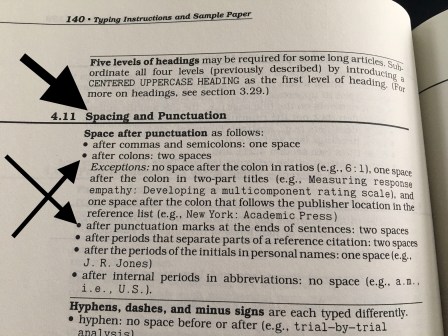
and so i just went upstairs to dig out-of-the-depths my old APA book – the third edition of the publication manual of the american psychological association, copyrighted in 1983, which was both the bible and the biggest pain in the ass for writing papers in graduate school. here it what it says on page 140:
i feel vindicated. heartened. validated. my two-spaces, although archaic, are supported by a rulebook. at least they w-e-r-e supported by a rulebook back-in-the-day. the newest APA book is copyrighted 2020 and is the 7th edition. here’s what that says about spacing:
ugh. (eye roll)
i don’t know if i will try to incorporate this “new”rule. like kevin, who said he was taught two spaces and is sticking with it, i just might not be able to do it.
at this point, i hardly think anyone will whip out their red pen.
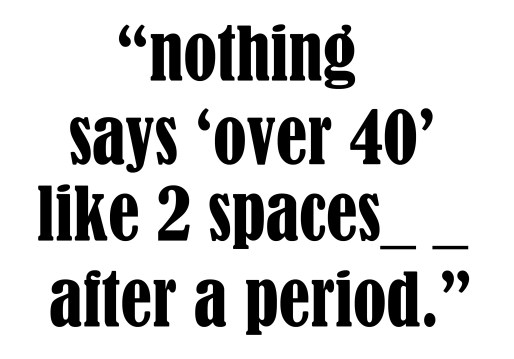
but i can hope that people – in reading my two-spaces-after-a-period-that-says-over-40-writing – will assume JUST a-wee-bit over 40.
the little red schoolhouse on cuba hill road was the place i went to kindergarten. built in 1903 it was a place of important early learnings – the stuff you learn at five and six – things this back-in-the-day first teacher, who you fall desperately in love with, would impart to you through kind, objective, steady lessons. it wasn’t that my sweet momma or poppo weren’t teaching me kindergarten-level-rules, but learning them in a place where i was surrounded by other children and could practice them immediately in-real-life i would guess had more impact. lasting lessons are often those that come through experience, through feeling and doing rather than simply hearing.
share your toys. take your turn. say please and thank you. wash your hands. do your own work. hold the door for others. keep your hands to yourself. be kind. help others. listen when others speak. be respectful of your elders. follow the rules.
i don’t specifically remember days in kindergarten but i know that i have always been a rule-follower in school and would not imperil another’s playground time by not paying attention, by disobeying, by being impervious to an adult’s directions for work that needed to be done or instructions for safe practices. i would not have ignored the be-absolutely-quiet rule during fire or duck-and-cover drills. i would not have continued talking or wreaking havoc were my teacher – or any other teacher, for that matter – to have asked for silence.
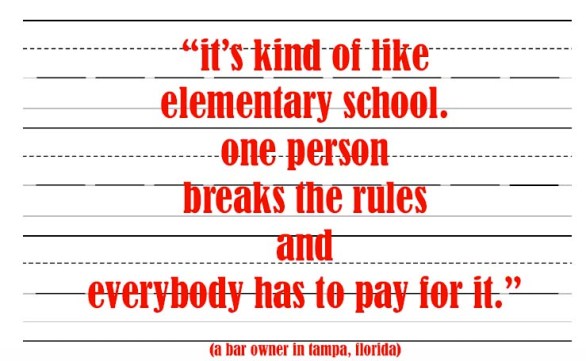
the rules seemed simple at five. we were each individually and as a group asked to follow them. those easy rules were designed to preclude chaos and our freedom to learn and have fun was never sacrificed in the process of following them. the consequences of disregarding them seemed dire – staying in during playtime. one child’s misbehavior often led to the whole class missing playground. to be THAT child was not a sought-after title. instead, we would work together – in our five-year-old beehive fashion – to clean up the classroom and desks and chairs so that we were all ready – together – to go play.
it’s the way i feel about masks. it hasn’t been recommended to us by medical and science professionals to wear masks as a lark. this recommendation comes with passionate imploring. it is a simple rule. if this, then that. conditional. if we wear masks, we will dramatically lower the transmission of this global pandemic raging through our country. it is a proven fact and other countries have shown their adherence to mask-wearing has flattened the curve of the disease. pretty simple, yes. a mask.
instead, there are those people who flagrantly ignore this simple if-this-then-that. we see them everywhere. it’s breathtaking. and their display of arrogant individualism at a time of an intense need to care-for-community means one thing: we will not get to go out to play.
i never let it stop me. it didn’t matter to me the title someone held or the notoriety they had. i always reminded myself that this person i needed to call or meet with or contact was human. “this person breathes in and out, just like i do,” i would think. i felt this person – whoever it was – must have some human quality in common with me, regardless of a possible overly-amplified ego or the protected life bubble they might live within. “it matters not,” my momma, a lover of language, would say. in the end, nothing really separated me from this person, him or her, human-wise.
and so, my slightly-dialed-back-new-york chutzpah would dial the phone and expect nothing less than speaking with the person i was calling, no matter what rung on the ladder that person clung to, no matter how high the ladder, no matter the pecking order or the person’s perception of self.
because: people. we are all people.
now there’s a starting point.
but you wouldn’t know that looking at this country these days.
my sweet momma would be 99 today as i write this. 99. even in her time on this planet – which devastatingly ended five years ago now – she had seen a lot of change. “it matters not,” she would say. we are where we are. she read, she researched, she asked questions. and she always arrived at the same place: people are people and should be – in the crux of all things – equally treated as such. period.
empty words ticked momma off and she warned me of people who would talk the talk but not walk it. her sixth sense of intuition was often caution enough in friendships and relationships where people would get all virtuous and principled and, yet, be the same people who could clearly not see the irony in their supposed loftiness, the empty in their words, the do-as-i-say-not-as-i-do-ness, the falsity in their stance.
my momma, our beaky, subscribed to kindness. it would be to her horror to see the hateful rhetoric nowadays. she would have no patience for it. she would point to the horrors that hatred had produced in years past. she would state in simple terms: “it matters not,” she’d say, “be kind to each other. in all things, be kind.”
if momma were here today, she’d wear a mask. not because she would be in a high-risk category, but because it is the kind thing to do. a lover of math and science, she would point to the words of scientists, researchers, epidemiologists, medical professionals and she would insist on listening to them. “it matters not what you think,” she’d point out. “what matters is what they know.”
if momma were here today, she might protest. she’d point to inequity and ask what we could do about it. she’d not draw lines of color or race or gender or sexual orientation or economic status. “it matters not. people are people,” she’d insist. she’d wonder at a country, with so many smart people, continuing to head down such a dark road. she’d question, she’d challenge, she’d debate, she’d be stalwart and she would hold steadfast to being kind. period.
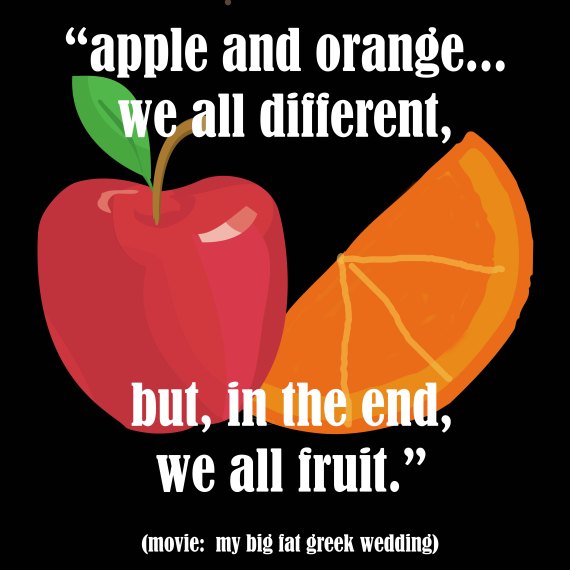
it may be oversimplification, but gus had it right in my big fat greek wedding. “apple and orange…we all different, but, in the end, we all fruit.” he and my momma would have been grand friends.
because in the end, we are all human. we breathe in, we breathe out. we can reject hate; we can choose to love. nothin’ wrong with a little oversimplification.
short attention spans. we americans seem to have eclipsed the rest of the world with these. we are a newsclip-sitcom-youtube-radio-cut-text-tweet-snap-insta society; often anything less than fast-paced will bore the viewer-reader-listener. we have reduced lengthy research to reading cliff notes and have lost interest in the documentary series in favor of the 22 minute-plus-commercials sitcom.
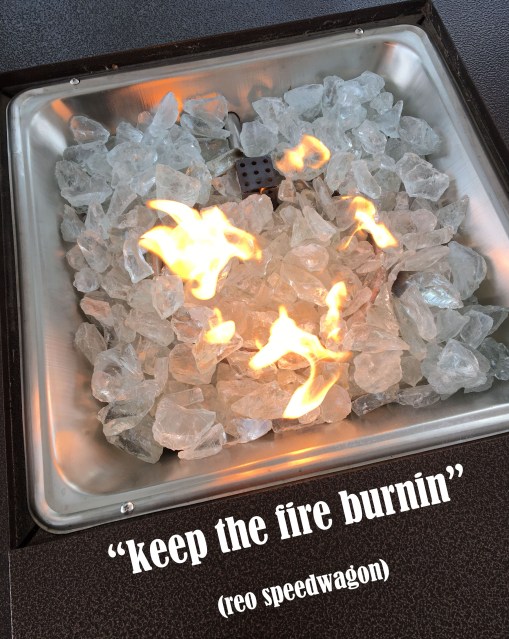
enter a global pandemic. three months now, we don’t have to go far to see that the novelty has worn off. just down along the harbor, up on the sidewalk tables, in the stores and the bars with doors swung wide open, it’s as if it no longer exists. pandemic-shmandemic. the attentiveness of many has been worn down; it is no longer possible for what-seems a vast majority to pay attention. they have moved on. the fire of fear and, thus, responsibility has reduced to a flicker.
we watch crowded streets with people protesting, begging for change, asking for the country to turn around and face itself and the underlying racism that has prevailed for centuries. we march, we chant, we write, we listen to speakers, we read books. it is the latest in the viewfinder for america. it is three weeks now. there is action. can we keep this necessary fire of change lit?
masks-and-distance-for-protection-of-all, action-and-change-for-equity-of-all, step-by-step, learning-by-learning. we all have to stoke the flames of transformation and push back against the ever-inviting-lazy-attention-lost backslide into complacency.
“and let us not stop learnin’. we can help one another be strong. let us never lose our yearnin’ to keep the fire burnin'” (reo speedwagon)














 reverse threading