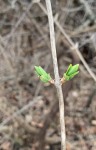
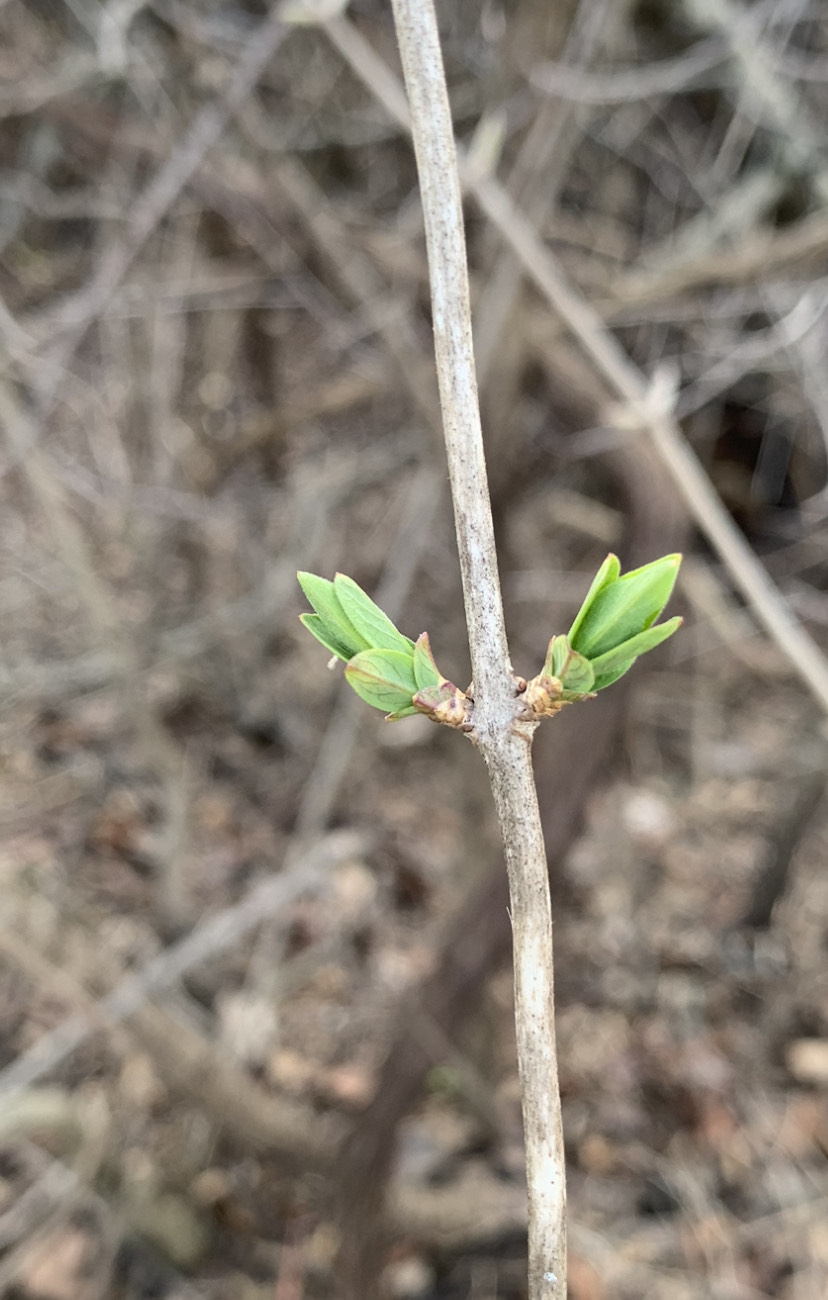
and the deadened stalks of underbrush began to show signs of life. instead of the greys and browns of winter, its lack of light and its deep shadows, the sun has drawn out buds of newness and there is a slight glow of green in the woods.
soon, that green glow will grow and it will push out all the shadows of what had been, of the eradication that had happened in the preserve, of the fires and the heavy equipment’s tearing and grinding of buckthorn and other invasives. soon, the green glow will reflect back the warmth of the sunlight of spring and regrowth and we will walk in places that are not heavy with the press of toxic plants or trees. soon, the green glow on stems of underbrush, on trunked branches of trees will distinguish goodness from that which chokes out life.
walking – in the woods – last summer, last fall, early winter – it was hard to imagine – almost impossible – to really grok – that the beauty of the underbrush and the forest was being overrun by that which would utterly ruin it.
walking now – in the woods – in late winter/early spring – still with its juxtaposition of the echoes of the dark and the light, new vegetation and old chokemonsters, goodness and destruction – it’s ridiculously easy to see the difference.
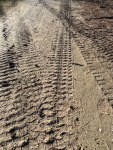
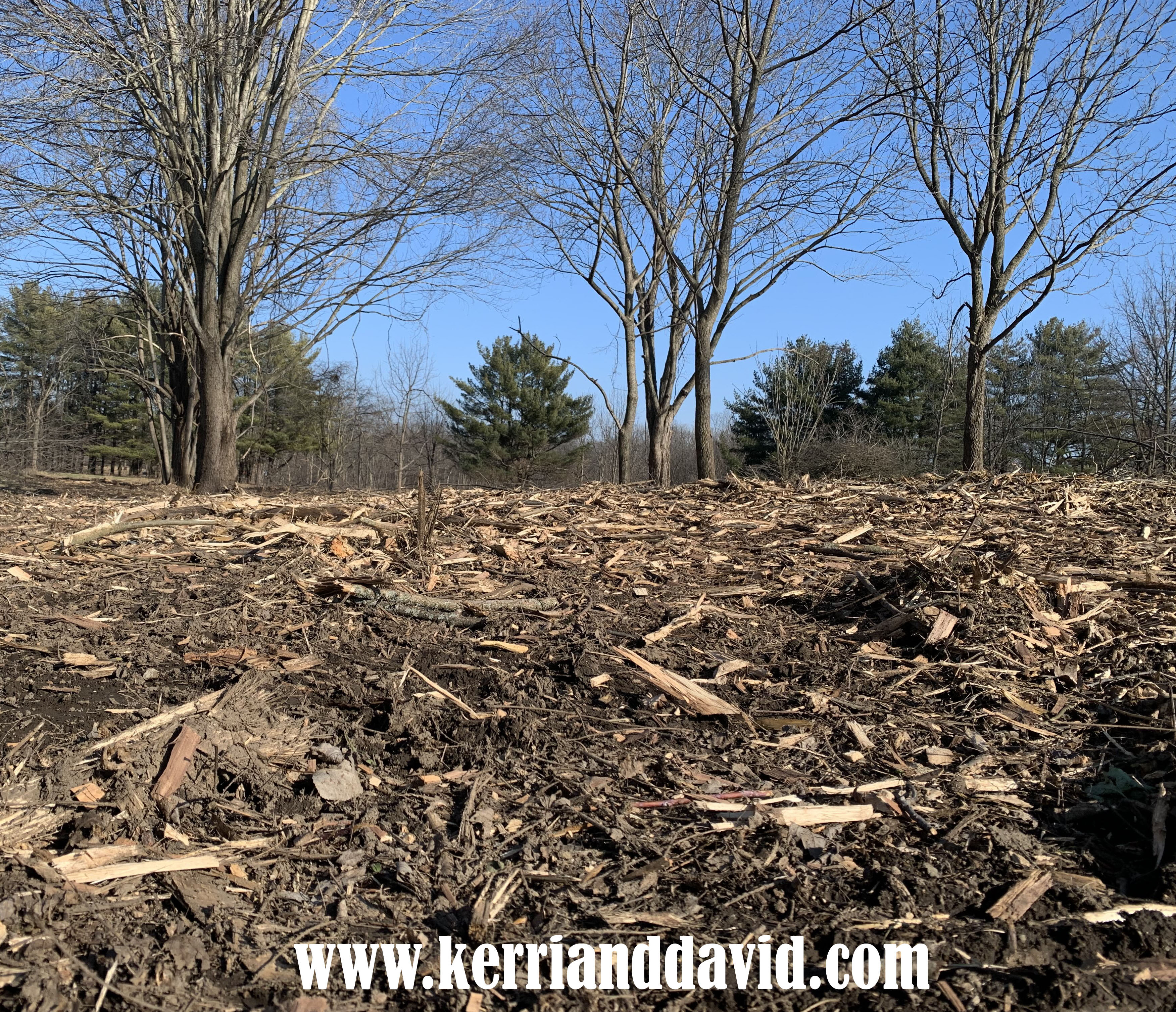
the tracks tell the story. they came in and mowed down underbrush and trees, grasses and cattails. all in the name of habitat restoration. apparently, there are buckthorn and cottonwood and boxelder and various other invasive species that are suffocating the growth of young native tree seedlings. it looked absolutely devastated. as did the back half of the woods earlier this year after they attended to that section. but there was space for the sun to get through, for air and a bit of new growth. it was necessary.
now, admittedly, the back half doesn’t look as raw as it did right after that earlier eradication. but – it does look different. just as – i suppose – this section of the woods will look…eventually. it’s the meanwhile that is a bit tough to take. it’s stunning to see such emptiness where there was lush. it’s bracing to recognize how long it might take for this area to grow back – to fulfill the potential the ecologists plan for.
but devastation is like that.
in devastation-light we have the basement/attic project. this will all look decidedly worse before it looks better. the categories – keep, donate, sell – are staged all over the basement and have spilled into other rooms in the house. eventually, this will get better. it will look different. right now, though, it is a ruckus of stuff.
all this review of the past, though…it’s good for my heart. tiny salvageable moments derived from these seeming willy-nilly piles…i am wrapped in the after-devastation feels. for this is chosen devastation – choosing to touch all that is in the house and decide about its fate. and maybe devastation isn’t a good word for that kind of parsing out. just because it looks like devastation doesn’t mean it is devastation.
but there will be more culling before there is something that looks and feels good: the cleared out, organized space that honors the before-stuff and makes way for the next. the same way it is for emotional clearing-out. it will all get much messier before it gets air.
the tracks from the backhoes and heavy equipment punctuate the trail. we may wait awhile – maybe a few rains – before we take that loop again. in the meanwhile, we’ll go along the river where the trail is longer and quiet and the trees and underbrush are untouched – at least for now.
we’ll continue our quest in the basement and the attic and every other nook and cranny. we’ll make messes and piles and categorize each thing we unearth.
and the emotional stuff, well, it will surface and it will recede – both. it will be like a tide – just like the basement, it is a choice to pull things out of their previous compartmentalization. just like the basement, it has the potential to be really messy. and, just like the basement, it will be tedious and time-consuming and it is possible for a bit of anxiety to creep into the spaces previously left wide open by keeping it all in boxes and on shelves. suddenly, it’s all free-floating and there are fragments of emotions and tangible pieces of the past right there in front of us.
so we climb aboard our front loaders and excavators and bulldozers. and we start plowing down all the invasives.
and we just may feel restored after it all. we will have relived many memories, touched – really touched - the evidence of time passing.
and we just may be rejuvenated. the new saplings will be free to grow.
and we will look forward to lush, breathing easier and feeling the sun on our faces.
they chopped down, chainsawed, mulched, chemicalized, burned. they decimated the whole forest to eliminate the invasives. and – in the way of oncological medicine, of environmental eradication programs, of corporate and organizational ousting – the good cells may somehow survive, burned edges and all.
to be a tree with burn marks is to be human. one cannot traipse through this life without them. we all carry with us whatever balm has helped us get through the fires. we lean on the surety that spring will come, eventually.
as we hike the trail, we know that it is not one hundred percent that only the good will keep on. it is not a certainty. instead, it is a risk, a gamble, that there may be cells that escape treatment, there may be invasives that escape annihilation, there may be people-in-power-with-ill-intent who either escape the pointed fingers or are the ones corruptly pointing them.
and in those cases, the worry is that those cells will reproduce, those invasives will take over and choke out the organic, those people will destroy the place. a ravaging burn. devastation. and the good cells, the good plants, the good people will be left to fend for themselves, to remain upright – stalwart – to grow despite the odds.
it is good friday for those who are keeping a religious calendar. a day of destruction following betrayal and many burned edges. as this sacred story goes, three days later there is a resurrection. and the targeted jesus rises.
as we hike the trail, we notice the green shoots growing out of the ground, their top leaves still blackened. we marvel at the tenacity of these plants as they garnered energy best-as-they-could, regardless of the burn. the good xylem and phloem somehow survived.
there are naturalists who are watching closely, tending to the native plants best as they can. there are doctors and nurses and researchers and clinical trial experts who are watching closely, tending to patients and health and life best as they can. there are, therefore, it would seem, allies who are dedicated to the truth, to transparency, to the best parts of an organization who are watching closely, tending to the burns of the sacrificed.
“i want to know if you will stand in the centre of the fire with me and not shrink back.“ (oriah mountain dreamer)
shrinking back will allow the devastation. standing in the fire – the center of the fire – will allow the resurrection.
*****
“and you were there in all of my suff’ring.
you were there in doubt, and in fear;
i’m waiting on the dawn to reappear...” (you were on the cross – m.mayer, k.butler, a.assad)
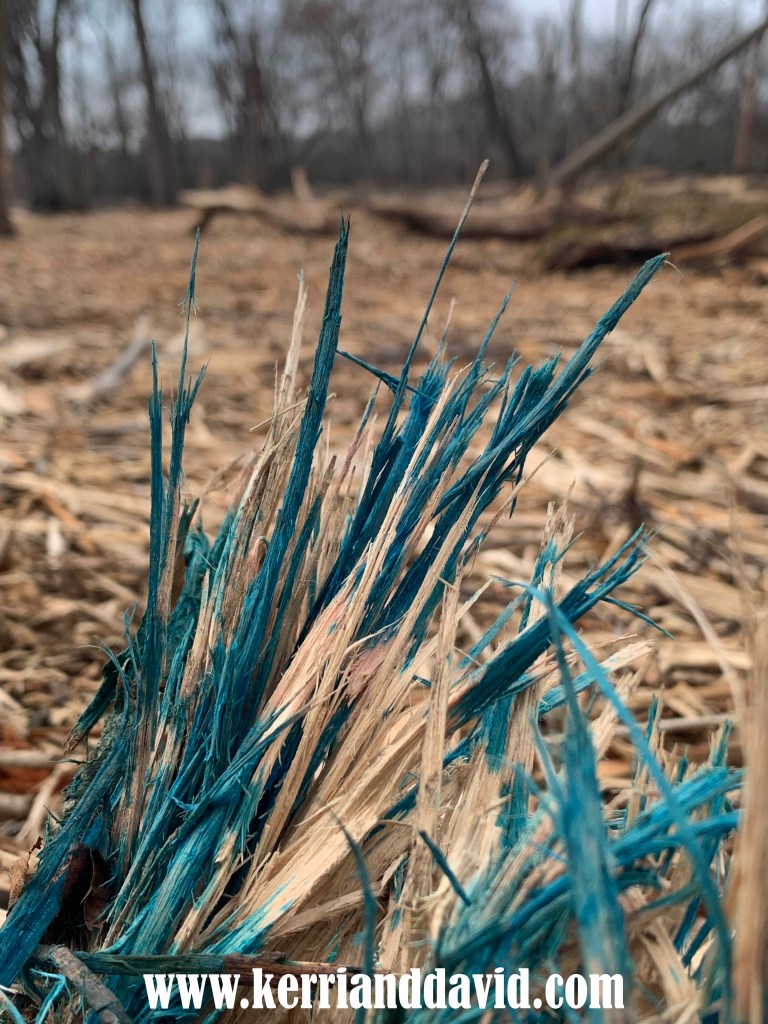
it looks like the hubbabubba fairy flew through, magic wand in hand, touching stumps and shredded trees everywhere. it is striking to see and not just a little disturbing. there is blue-fairy-dust-smattering all over the woods. trees have been felled, underbrush torn up, everything ground into rough-hewn mulch. one shade of blue and many shades of brown.
only it’s not magic dust and no hubbabubba-bubble-gum or jolly-rancher-blue-raspberry fairy has been there. instead, it’s an herbicide and part of treatment for the invasive species eradication project on our trail. it’s completely and understandably important, but it sure doesn’t look very nice. right now, it looks a tad bit decimated, but good strong organic matter remains and will grow and rejuvenate, despite the eradication of so many toxic invasives.
we need be cautious. often the invasive stands in the forest, all tall and righteous, and we are convinced that they are a beautiful partner in the woods community. or the invasive is short and squat, pudgy bushes that look lush and, again, we are convinced they are contributing members of this symbiotic woods. careful discernment is necessary, for we can be easily fooled, particularly by those invasives that look mighty or seem healthy. and these mistaken identities can – as we have learned – lead to the detriment of the very lovely and thriving woods.
that’s the thing about invasive species, i guess. you don’t recognize them as invasive. you trust – as you look around – that they are supposed to be there – for the good of the woods or the preserve or the wetland or the lake. here, in this woods, they appear to be a part of it – ever-present, growing and greening up in the spring. according to the national park service, “invasive species—nonnative organisms that cause harm to the environment, economy, or human health—have serious impacts on native ecosystems. they disrupt ecological processes, threaten ecosystem integrity, degrade cultural resources…”. they are not what they appear.
i suppose there are institutions like that as well. invasives choking out the real life, the real growth, the organic nature of the organization – all bent on preserving their own agendas, maintaining control, practicing a generalist survival strategy honed through the years. bobcats and coyotes are generalists and, i must say, i know a few.
the national wildlife federation states, “detecting new invaders quickly, and responding rapidly to eliminate them, is essential to limiting impacts and costs when prevention fails.”“many invasive species thrive because they outcompete native species for food.” i suppose it would be wise to be wary of being outcompeted.
“many invasive species destroy habitat” and “some invasive species do great harm to the economy,” national geographic warns and then adds, “invasive species are almost always spread by human activity.”
“you can treat and dispose of invasive non-native plants by: spraying with chemicals, pulling or digging out live, dead or dying plants, cutting back plants to prevent the seeds dispersing.” (gov.uk)
yes. these are some of the efforts we are seeing in our own treasured woods: the removal of the toxic longstandings – masked as steadfasts participating in the mission of the forest – for the true benefit of that forest and wildlife community.
“once invasive species become established and spread, it can be extraordinarily difficult and costly to control or eradicate them.” (national wildlife federation)
in that light and with great intention, in one dedication to such efforts, “the national wildlife federation leads the charge to prevent invasive carp from entering and decimating the great lakes.” the national park service explains, “invasive carp cause serious damage to the native fish populations in the lakes and rivers that they infest because they out-compete other fish.”http://www.invasivecarp.us asks fishermen who catch a carp to “immediately contact the appropriate agency personnel for the state you are in.” we are urged to be ever mindful, to be transparent about what we see, about that which is destructive.
yes. watch out for those carp and all the other invasives. the hubbabubba fairy has left the building.





 reverse threading