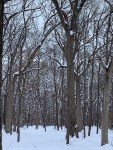
on a cold and cloudy day, the colors are muted. it is stunning. the trees have reached out and caught the snow as it flew by. the branches have held onto it, inches of white topping a narrow spectrum of greys and taupe, some tree trunks black in the dim. it’s quiet. we are – on most of the trail – first there, save for the deer and squirrels and rabbits who have left behind evidence of their passing. gorgeous. i am not cold, though the temperatures have plummeted. i feel wrapped by the woods, embraced. the paradise of winter is not on some beach somewhere. it is right here, in the middle of fallow.
it occurs to me that the colors there – in the woods – are the colors in our living room. i see now why – both – they are the colors we have chosen and why they feel so peaceful. the woods is in our living room.
i turn out all the lights – each lamp – the standing lamp, the side-table lamp, the lamp in the window nook, the lamp on the secretary – but leave on the twinkling white lights on the tall branches. they light the room just enough. they are the outside, brought in, a branch from the cherished tree in the front yard, a branch from the woods. they rise high above the old wood floors and bathe this room with starry light. they do not hold the snow as it falls any longer, but they hold memories and profound reminders of the rhythm of nature.
this is, yes, i suddenly see, why this is the palette from which our living room has evolved. it is muted, a quiescent slate from which anything can grow, in which any burst of new color blossoming is celebrated, a serene woods any time we need it.
“not like my mom at all,” she said, talking about decorating in an exquisitely joyful conversation. she described her template, “the colors of a desert sunset.” i was instantly in a different place, watching the sun go down over canyonlands and high desert. i can sooo understand surrounding yourself with the divine colors of these moments; i can sooo relate to taking them with you.
as a person who has surrounded herself with rocks and sandstone and sticks and branches and feathers and pinecones of the high mountains, i get the connection to these places and the desire to live within them, even if you are not there. she went on to describe the colors, a template that made me want to immerse in them, like a favorite quilt. i lingered in every word she spoke, this beautiful, creative daughter of mine, trying to remember each one just as she described it, store them away in the kaleidoscope of treasured bits of knowledge.
i walked around our house after that. black and white. a little bit of flour-tortilla. green plants. old clay pots. old wood floors. there’s a certain ochre in our sitting room and in the stairwell going upstairs. and there’s some barn red in the bathroom. it’s kind of a cross between the extremes of ansel adams’ color palette or sheet music tablature, golden sunrise moments, a new england farm, deep woods in the mountains, canyonland red rock.
the photographs i take everyday and everywhere vary. but lately, i have found myself drawn to these small canvasses of almost monochromatic still-life outdoor paintings, just waiting on the side of the trail, waiting in flower gardens, waiting in the woods. nuances of shade, a tiny pop of color … nature’s natural inclination to visual cohesion. i’ve been especially seeing the greens in the greens, really delicious shadings, no competition for spotlighting, just color intertwined and inclusive. i’ve noticed even more distinctly the genius of a single bloom, petite berries, nestled in all the verdant green.
i came home from such a hike one day recently and took out the 1940s opalescent aqua blue hobnail glass vase that was my sweet momma’s. it reminds me of sky and water; it reminds me of grocery store flowers my dad always bought my momma. it doesn’t go with our house, i had thought, going through bins and boxes. and then, i placed it in the window seat of our black and white and flour-tortilla living room, a gentle nod to days spent in the grass drawing with clouds and on long island beaches with coppertone floating in the air. a “yes” to my daughter.
she is right. the colors in our home aren’t the incredible desert pastel spectrum, the intensity of sage peacefulness our girl described – the sunsets she holds close to her soul. but it is as particular to the desire to surround oneself with that which is meaningful, to what resonates inside, to what gives you serenity, keeps you still in all the whirling world, brings you contentment, is part of the nirvana of tranquility, is your sanctuary. it’s decorating with true heart.
yesterday david wrote these words about his palette. as i read his words, i realized he was conveying many of my own sentiments. with his permission, i have only slightly modified his words this morning to express my own artist palette – my piano. the re-posting of this, and even using the same verbiage, reminds me of the intertwining of all soulful expression. bear with me as i experiment, my words in red, an exploration of two artistic planes running parallel.
true confessions: i never rarely clean my palette the music stand on top of my piano. i like the messy build up of color. color is found in many forms but mostly notebooks and pa-pads, scraps of paper, snippets of tracks recorded on an iriver or an iphone. i like the chunky texture pile. it serves as a gunky history of my work, a genealogy of paintings compositions past and future. and then, over time, it becomes a tactile work of art in its own right. unfettered by any of the mental gymnastics or over-ponderous considerations that plague my “real” work, it is the closest to child-mind that i will achieve. it is accidental. it is free. it is idea, melodic gesture, poetry waiting for notes, phrase waiting for the rest of the lyrics. ready. waiting. free.
this might be a stretch but it is, for me, nevertheless true. i love my palette because it is the place of alchemy in my artist process. it is the true liminal space. long before the space spanning the route taken from introduction to coda. i begin with pure color. i begin with the rest, silence inbetween the notes, the place for breath so you can hear the vibrations of sound. i smash the pure color together with another color and transform it into a third color, the hue i intend. note upon note i build a melody, smashing note upon note i build a small unaccompanied orchestra of harmony, the hue i intend. on a palette, color becomes intention. sound becomes intention. and then, once transformed, with a brush or knife i lift the color-intention from my palette and in an action that is often more responsive than creative, i place it onto a canvas. i play, i listen, i play again. i lift it from the keys of my palette and place it onto the canvas of paper, attempting to capture the fleeting moment it has created and etch it into a piece of music that can be repeated, played again. it transforms yet again relative to all the color it touches. it transforms yet again relative to the air in the room, the echo of an intention, the listening ear it touches. an image emerges. more color is called for. it emerges, this composition of music, and more color is called for.
and, somewhere in this call and response of color, i become like the palette. the pass-through of alchemy, the door that color passes through en route to something beautiful. and somewhere in this call and response of color, i become like the palette. the pass-through of alchemy, the door that color passes through en route to something beautiful. this! can there be a more pure statement of artistry? and, in the process, perhaps i, too, in my messy build up of life/color, grow closer to that child mind. unfettered. accidentally interesting. free. and in the process, perhaps i, too, in my messy build up of life/color, grow closer to that child mind. unfettered. accidentally interesting. free. the rest between the notes. the breath of music on the air.
“You never know what is enough until you know what is more than enough” ~ William Blake i paint. i write. i compose. i don’t know what is enough until i know what is more than enough. truth.
we really never know what it takes to do someone else’s job. we don’t know all the tools used, the research done, how training and experience play into it, how someone perceives their own work. we can only guess and, often, fall desperately and even arrogantly off the mark.
walking into d’s studio my eye is drawn to the easel standing in the far corner. closer to me, though, is an old cart with an old wooden box holding paints and brushes. there is another cart and on that is this palette – layers upon layers of color and texture, clay pots of water standing next to this widely-understood symbol of “artist”, often associated with the beginning of the process of painting.
now, i’ve painted a few paintings in my life. i bought very large prepared canvases and dug around in the basement for leftover acrylic house paint to use on my creations. without a palette, i brushed and re-brushed and threw paint until i knew each painting was done. and then i hung them on the walls. in one case, i painted right on the wall and put a clearance frame around the section of wall that i painted – a nod to a painting without the cost of canvas.
all of this, however, does not make me capable of really understanding how d paints. for i do not know all the tools, i do not know the process of mixing color or the technique of stretching canvas he uses, i do not know the tricks of the trade he has accumulated over decades of honing his expertise. nor do i know the knowledge base he brings about other artists, other painters and paintings, the use of light and dark space, the way the viewer’s eye sees, the very technical details and the very heart-based intuitions he has learned through many, many years of study and practice. i can’t understand or even try to predict the amount of time it takes or doesn’t take for him to conceptualize, to explore, to create, to review, to assess, to adjust, to re-create. i can respond to his work but i cannot define it, nor would it be meritorious for me to even try to do so. out of respect for his work, something that is one of the very things that defines him, i know that i really have no idea. what i can do is appreciate his talent and every last thing that he has done to bring him to this place where he paints beautiful paintings and it seems to take no effort whatsoever.
with regard to anyone and the work that they do, i would hope we could each remember – with humble respect – that we really have no idea. we can just be grateful that we are each a spoke in the wheel on this good earth. our palettes, the places from which we begin, are different. and we can’t do it alone.







 reverse threading