of course it would have been easier to turn around and go back to the car.
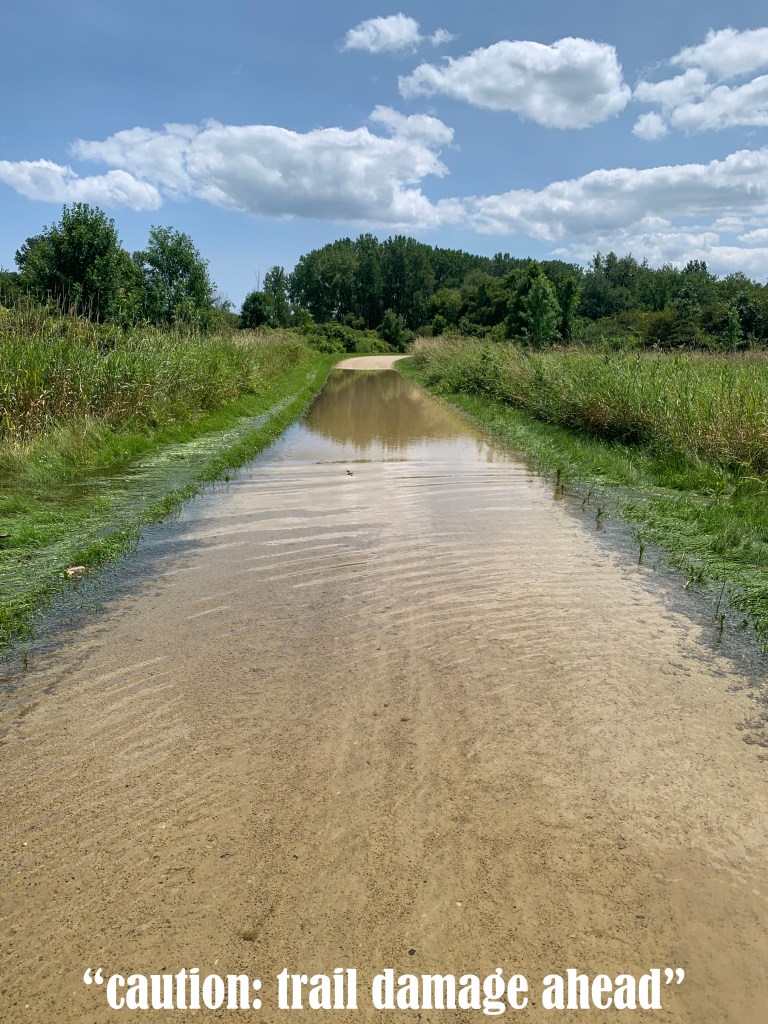
but the signs “caution: trail damage ahead” are familiar to us and we just kept on going.
then we saw the first of it. the river had overflowed its banks and covered the trail. i took a few pictures after we decided to keep going. i don’t have pictures of the worst of it. we were too busy navigating the water.
but, yeah, we could have turned around.
we didn’t.
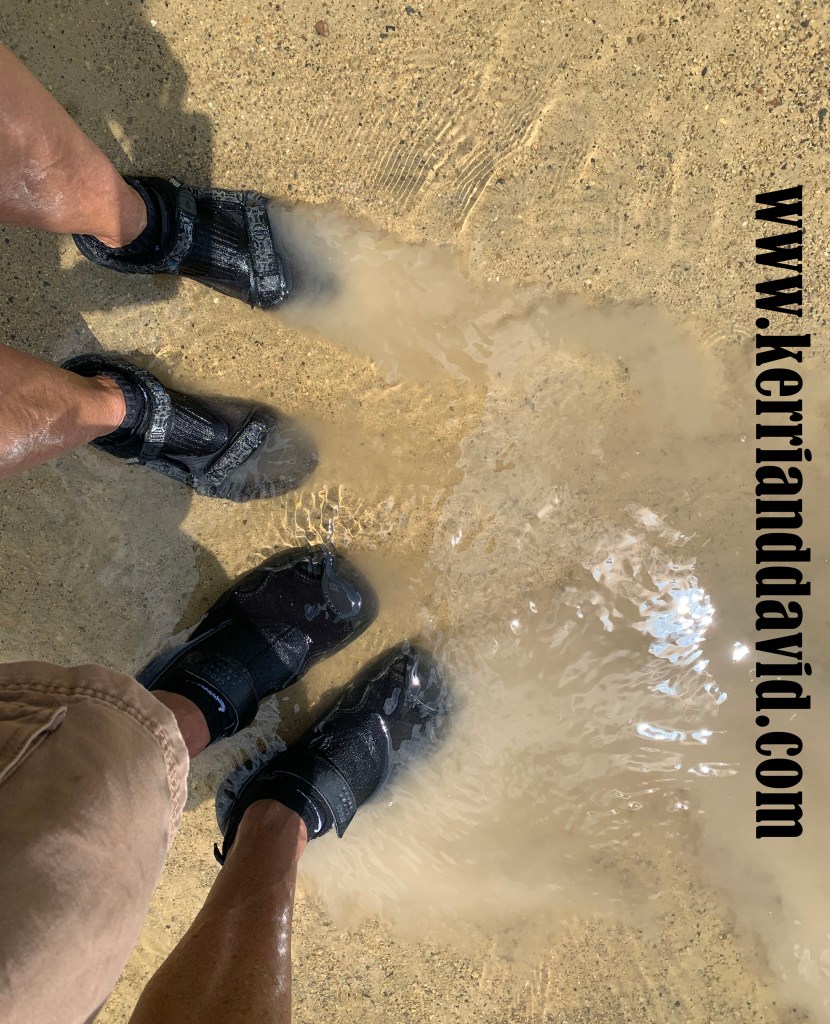
it was a stunning day – really, remarkable out – and we had on sandals that were fit for the river. so we kept going.
we have watched countless pacific crest, appalachian, continental divide, colorado, arizona trail videos. and in all of them hikers are forging streams and rivers, slogging through water and mud. watching, i have wondered – in a mildly curious and very respectful way – what it feels like to encounter these water crossings and to keep hiking with wet socks, wet footwear. not that i haven’t ever walked through puddles – i’ve done that deliberately – but because continuing to hike means also trying to avoid blisters and such. twenty miles plus with wet feet is nothing to sneeze at. big kudos to those thru-hikers.
we looked at each other on the edge of the first flooded area – this particular day we had chosen this particular hike – and we kept going. we needed to. we’ve navigated worse trails in real life – a little water didn’t seem so daunting.
there were some bicyclists on the trail – they had already been through the worst of it. they gave us looks, asked us how we got through, told us they were turning around to avoid it.
but there is nothing like wet feet to cool you off. we hiked about seven miles or so that afternoon – through a lot of water – that reached our mid-calves. it was more than a little water. we were one with frogs and fish – all sharing the trail together. it was all pretty glorious.
keeping-on-going is something we’ve gotten pretty familiar with. not just on the trail.
you don the right sandals and the knowledge you can do it and most crossings are possible. going slow, keeping your balance, not minding discomfort, sloughing off the looks you get – when you are following your path – diligently aware, capable, trying your best – you can dog-with-a-bone keep-on-going.
it doesn’t mean you’ll not stumble. it doesn’t mean you won’t get wet or that you won’t get blisters from the experience. it doesn’t mean you’ll get to the other side without some surprises. there are no guarantees. edges are like that.
what it does mean is that you gave it your all.
we didn’t know how the flooded trail would turn out – how our hike would turn out – but we kept going anyway.
buymeacoffee is a tip-jar website where you may help support the continuing creating – like this blogging – of artists whose work is meaningful to you. ♡
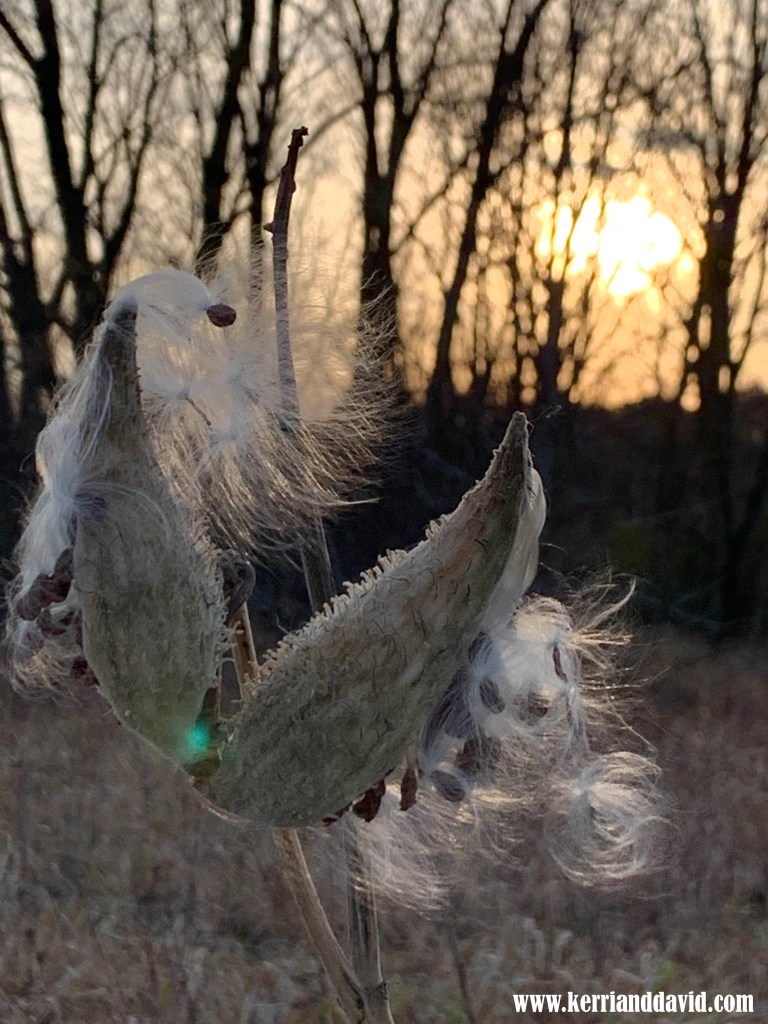
the orange sherbet sky is a stunning backdrop to most anything but the milkweed’s wisp is anything but most-anything.
we pass by and notice. we pay attention. texture and color and movement from the gentlest breeze – it is a photograph before it was a photograph. my job was simply to snap it.
our days are slower. we linger in not-knowing. we acknowledge time as it sneaks by. and the next week comes before any of us are ready, before it seems possible. even the milkweed is surprised.
we are learning lesson after lesson. that this is life: the things our fingertips touch, the scent on the wind, the view before us, the call of the black-capped chickadee, the ground under our feet. we are caught up by the impermanence of it all. we are realizing the folly in the gathering of stuff. we immerse in the river where there is no stratum. we feel the moment, without knowing the edges of next.
the orange sherbet sky doesn’t dawdle. color has another place to be. and as the sun drops below the horizon, the shadow-gaps fill in.
we stand with the milkweed in dusk, close, loitering in early night and, with gratitude and rest, ready for next.
“workers might want to consider these top 10 skills, which employers say are rising in importance over the next five years: 1. creative thinking.”(jane thier – fortune magazine)
mm-hmm. yup. #2 is analytical thinking. i’m pretty certain that without creative thinking, analytical thinking would hit dead-ends every time. and self-destruct.
the other night, in the middle of the night, the wee hours of the night when one is supposed to be sleeping, i was – shockingly – wide awake. we had a long conversation, chatting about places we had lived way-earlier-on, jobs we had way-earlier-on. i talked about eating lots of kellogg’s cornflakes and he talked about mountains of pbj sandwiches. we have both had histories of piecemeal, making-it-work, scrappy artists weaving a tapestry of living with rough-hewn shreds of granola-cotton, jute, hemp, fabrics not fine or finished but with torn edges and maybe a little holey.
larkfield road in east northport made it possible. many of my jobs – early-on – were on this road. i worked at the music store, the camera store, the dive shop, one of the churches – all on this road – before i left long island. i bought my cornflakes at the king kullen and my gas at the corner citgo, splurgy pizzas down the road and sub sandwiches next to the post office. i drove all over teaching piano lessons and saved whatever i could at the bank that gave away plates for deposits on the corner of larkfield and clay pitts. none of it was fancypants. but it gave me a different expectation bar and it was all setting the stage for a creative life.
it’s funny to me that it takes a fortune magazine article to espouse the merits of creative thinking. the number 1 top skill rising in importance – as if it’s something new. ahhh. but, perhaps it is.
for we know, better i’d say than many, the difference in actually choosing a creative path. creativity, artistry – these lead you in a direction that is unrevealed, a direction that is vulnerable, a direction that has no guarantees.
an accountant, say, knows that any amount of time spent on a project will be remunerated. time spent = time paid for. it’s really a lovely equation. and both of us have had positions in our lives when this equation was in place.
but the instant we list back to the artist side, all equations dissipate into a fog and people – the same ones who turn to the arts in watershed moments of their lives – suggest we might consider exposure of our work our form of payment. i imagine writing to the wisconsin energies company – “i’ll give you ten exposures for this $326 bill.” more so, i imagine their response. yikes!
and so, here we are. the workworld – so to speak – is catching up a tiny bit. employers are beginning to recognize the value of creative thinking…maaaybe. the COO of fortune, dan shapero, is quoted, “the long-term trend is pretty undeniable that the demand for skills outpaces the supply of skills.”
perhaps he – representing employers everywhere – is not looking in the right places.
creative thinking is found in creative people, the ones exposing their work to the world, the ones who scrimp and bring to fruition projects that started in a thought bubble, the ones who don’t have the same organizational principle applied to their vitae and whose vitae, perhaps, would go the way of bot-trash, but who have a thru-hiked life (sometimes many, many years of life – decades even – making age yet another employment challenge) – with creativity their north star.
as people-with-active-resumes we note that our schooling is bachelors and masters degrees – framed and unframed- in bins in the basement somewhere. our work experience is a little bit of that tapestry i was talking about. it’s been garnered in educational settings, in corporate settings, in public service, in non-profits like theatres and churches, in software startups, on stages and on radio, in studios with canvas and studios with microphones. our creative output is found in albums, in paintings, in books, in blogs, in cartoons, in plays, in workshop projects.
we get creative thinking.
i passed green eyes down to her. he got his eye color from his dad. both of them are wildly creative. their lives have already been a tapestry of edges. i couldn’t be more proud.
“the most regretful people on earth are those who felt the call to creative work, who felt their own creative power restive and uprising, and gave to it neither power nor time.” (mary oliver)
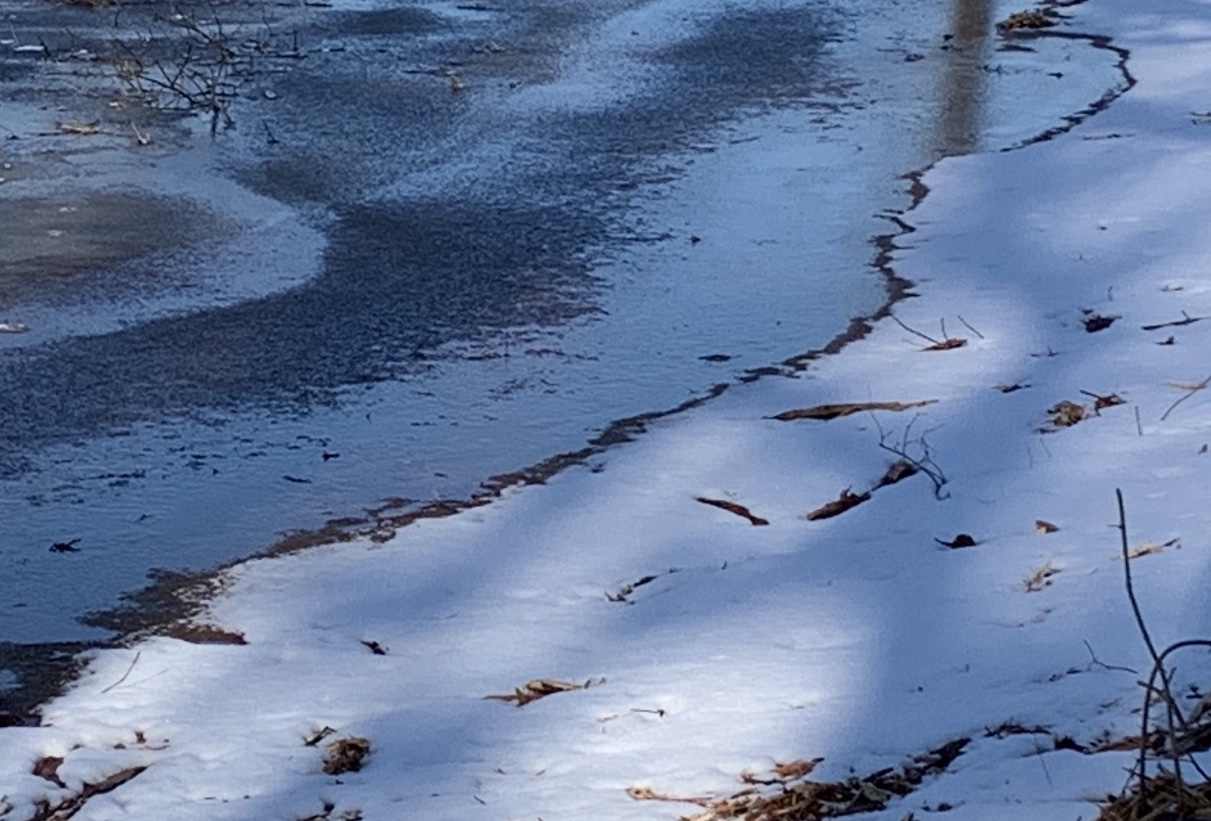
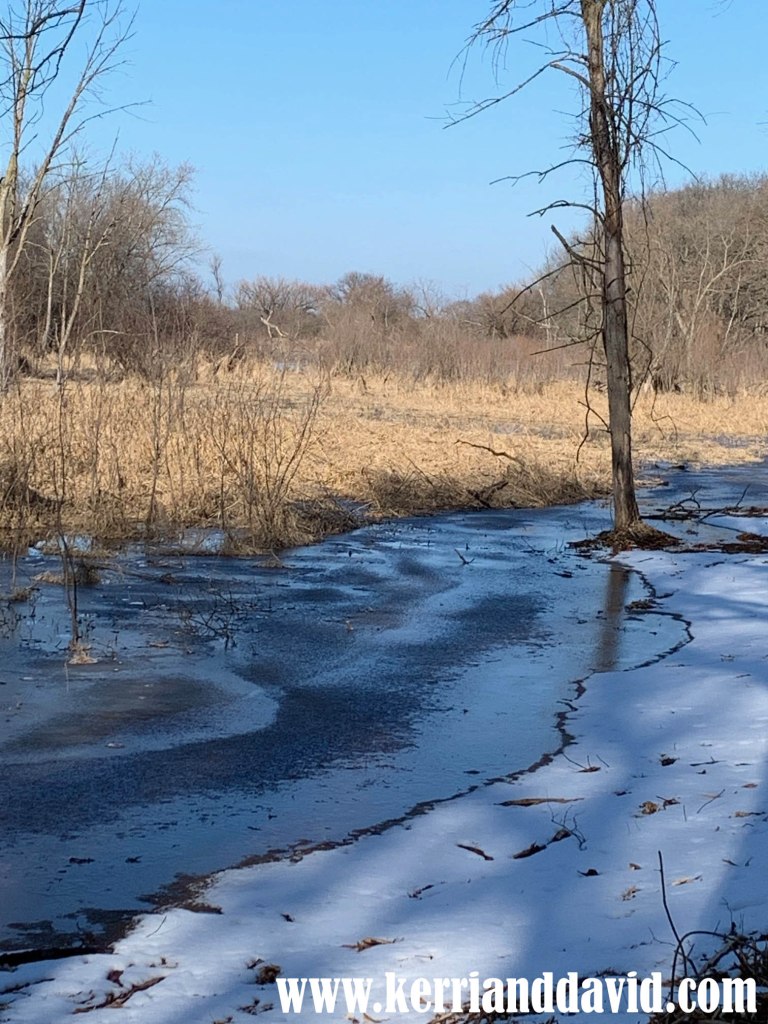
the fine line between snow and water. it curved along the shore, made more obvious by the mudline separating the two. the edge between frozen and watery marsh appeared like a crayon thickly outlining the coloring book image, colored in with either whitish snow or blueish water.
standing on the shore – away from the edge – it’s pretty easy to see it…the place where, if you step, you will fall in. undoubtedly, there is also an area close to that place – but not as obvious – where you are also likely to fall in, where your boots will get all wet and perhaps you might lose your balance. you will be – maybe – covered in snow and mud, but you will be laughing there, because you will not have been in danger and it is not likely that you will be hurt. cold and wet, yes. but in real danger – no.
in a time of reorganization of our life together, we are trying to step closer to the edges…the ones we can see and the ones we can’t see. there are places and things that are oh-so-familiar to us, comfortable smushy places into which we sink, easy places to live in. there are places that push the envelope, places that push back and question and, even in that less-smushy-but-necessary zone, we steadily take steps. then there are those places that are a little frightening, a little less solid, a crossing-over place. these are the places we are finding we need to go now. we carry with us all the tools of our lives – education, experience, work, learnings along the way. as artists, as people working in the world, we toss our work over the open water so that it might float around and land – sometimes inside the edge, sometimes out past the buoy and the ropes that designate safe swimming.
and so, in the edge-approach, we glance down and see that our boots are getting wet. the leather – quite worn and no longer waterproof – is taking on marshwater. our socks are getting damp. but, we remind ourselves, we are not in danger. we are simply at the edge. there is much room for growth here, with our feet all wet. there is time to breathe and slow down our fast-beating hearts as we keep going. there is no worry about having to swim or tread water, for it is shallow. and the shallow water offers plenty of nutrients to feed us, teach us, keep us going. the edge looks scary and unfamiliar, risky, but we can see the horizon and the sky meets the land and we can recognize that.
every time we release an album, hang a painting, publish our words, stand in public with our art, openly protest unfairness – whatever it might be – we stand with feet on either side of the edge. we vulnerable ourselves to the world and we are in open water for the moments in which we allow ourselves to consider how our work – our standing there – is being received. but the foot that remains on solid ground – the one on the other side of the edge – holds us to terra firma. and, each time, i suspect, we have found it to be less scary to take the leap, not knowing.
i suppose right now should be no different.
“life is a travelling to the edge of knowledge, then a leap taken.” (d. h. lawrence)
i did a photo shoot with my cello. it’s a gorgeous instrument, elegant and full of tear-your-heart-out melodic possibility.
i am sitting at the edge.
i clutch onto it tightly, yearning to yo-yo-ma, yet knowing this edge is somewhat irrefutable. in my heart, my wrist, the tendons of my fingers ache to bow, to press string to fingerboard. the edge pushes back. i know that it is time and that no dream in the night – onstage with soaring, weep-worthy lines – will change that.
my edges – like conglomerate rock, a mixture of wishes and knowings and new – reorganize in the kaleidoscope of life. and, because life is like that, surprises will show up, lit by spotlights and sunlight.
and, once this stunning instrument has moved, as it should, from my studio to the embrace of someone else, i understand that, though my hands will not touch its graceful lines and resonant soul, there will be other learnings, other touches. and always, other edges.
“though i play at the edges of knowing, truly i know our part is not knowing, but looking and touching and loving.” (mary oliver)
i was going to write about the gig economy. about how living a life – mostly – in that world has given me a perspective about work that is maybe a little less rigid than the perspective of one who has worked outside the gig economy. always piecing it together, always scrappy, always thinking of the next new thing to create – these are second nature. not having as much, worrying, repurposing, having thinner margins – these are also second nature. in the middle of the middle of what-next thinking, outside the box of indeed and monster and ziprecruiter and simplyhired and random sites that seriously suggest i apply for positions as a neuroscience researcher. “now what?” people will ask – mostly who don’t really know me or who are drawing comparisons with their own lives. i was going to write about all that.
but then i thought about beauty. i thought about how artists dive below the surface, try to find the depth of meaning, try to hear and see what which others might pass by, not noticing. i thought about stages and boom mics and connection and standing in front of a diebenkorn – or a robinson – deep inside, marveling. i thought about arvo pärt and his absolute tug on my heart. i thought about john denver and simplicity. i thought about recording studios and soaring string sections, cello lines that make clouds rearrange to allow in light. the weaving of intricate relationship between people and nature, between people and art in any form.
there have been moments – and i can actually remember them – when i have been driving and listening to a song and i weep or hiking and seeing something so stunning i stop and cannot move. these moments when i know, without a doubt, that it was right to turn down the business-school-accounting-program acceptance. these moments when i know, without a doubt, that i will not have the same security as the person-i-would-have-been following that route. moments when i feel a sense of pride to be a tiny part of the tapestry of what people turn to in time of rejuvenation, of rest, of crisis, of pure bliss. these moments when i know, without a doubt, that somewhere along the way what i have done with my time has touched someone, has opened them, has taken them diving with me. below the surface of this great big world – to beauty.
your toes curl. your breathing is shallow. adrenaline rushes. your legs are a little shaky. your hands feel tingly. butterflies in your belly. you are on the edge. in that tiny place between before and after.
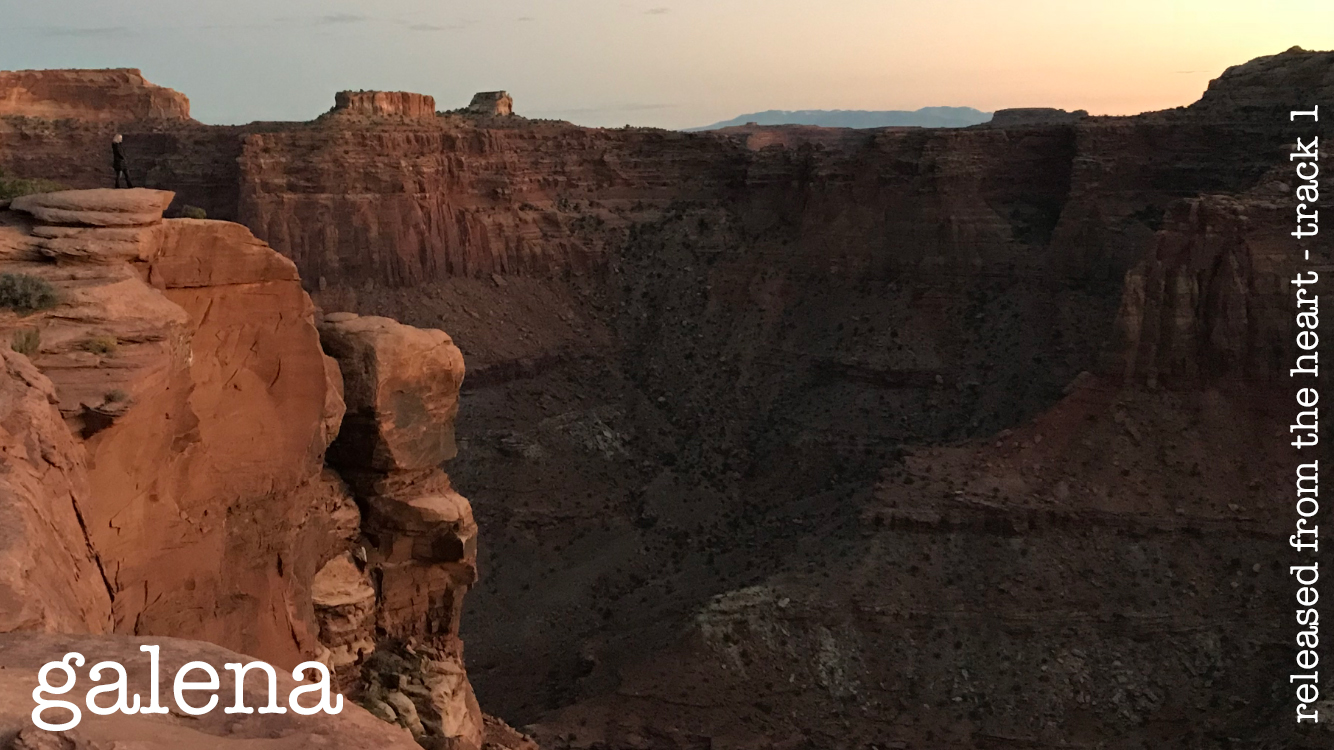
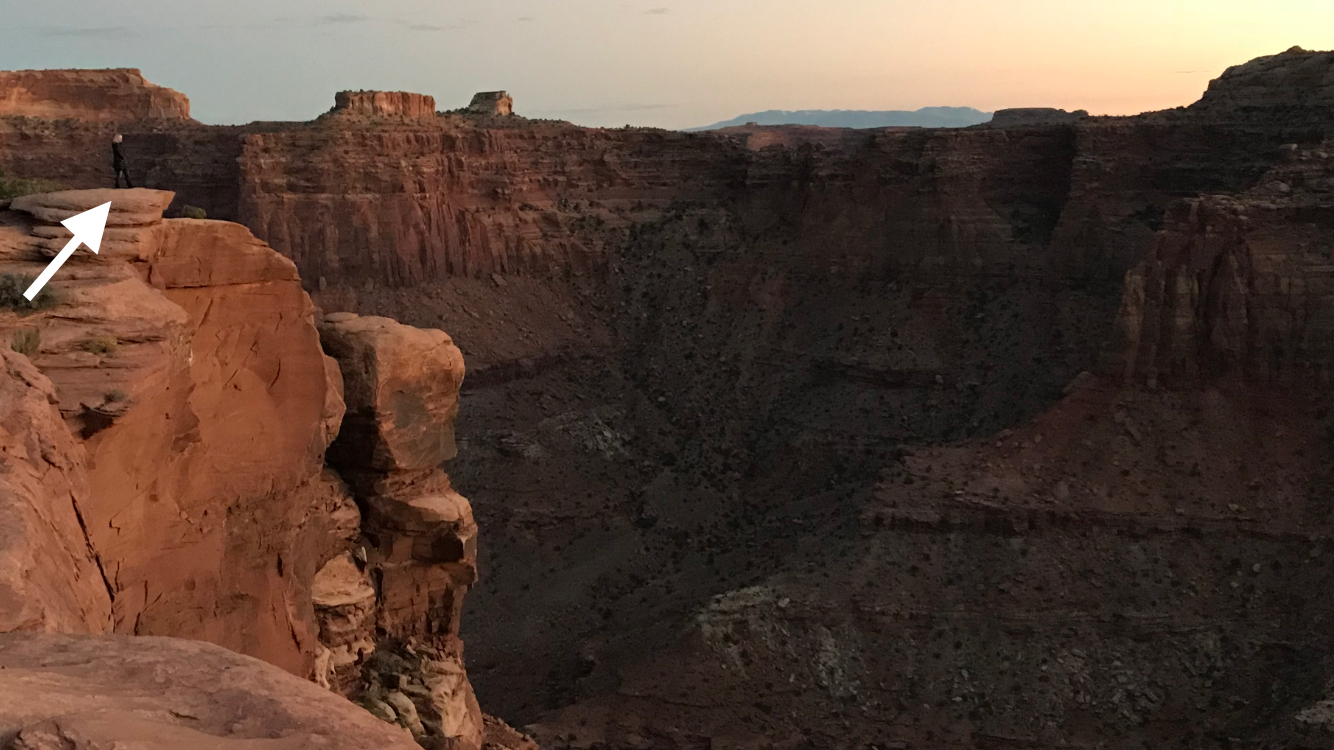
i gingerly walked to the edge of the canyon, my daughter encouraging me. at the moment i stood there, feet firmly planted, no guardrail, nothing between me and canyon wall, my heart slowed down and i breathed in both the enormity of the moment and the taste of both before and after. my girl and i laughed, loudly, the sound echoing across the vast canyon. and then, it was after.
i sat at the piano, ready to record this first piece GALENA of the first album, 24 years ago, savoring the safety of before but ready for after. at the edge of the put-it-all-out-there canyon, i walked onto the stage, brand new cds in the lobby, ready, with quivering knees and boots that gave me confidence. and then, in what felt like a minute, it was after.
now, many album and stage edges later, many life and love moments later, many work and play split-seconds later, i wonder what the next after will be. i can feel the edges; i can see them. i’m aware of my toes curling. my breathing is shallow and adrenaline rushes. my legs are a little shaky and my hands feel tingly, butterflies in my belly. there is a canyon beckoning.







 reverse threading