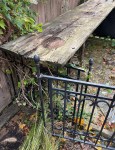
in the initial moments when we clear our barnwood potting stand – pull all the plants for composting, stack the clay pots and garden tools to be put away, brush off the stand, close the wrought iron gate, and then step back – i feel a sadness for the loss of our tiny garden. this year yielded a wild crop of herbs and tomatoes, jalapeños and lavender. we thoroughly enjoyed our sweet potato vines and our miniature licorice plant, the sweet dianthus, our peonies. this summer’s heat and humidity was a boon to our backyard. so it is somewhat hard to see it ending.
but the tacet of our garden – after such an amazing fully-bloomed tutti – is just as important in its performance. the quiet of this time will serve to gather its energy, to bring impact to subsequent growth, to give rest to roots bound by pots.
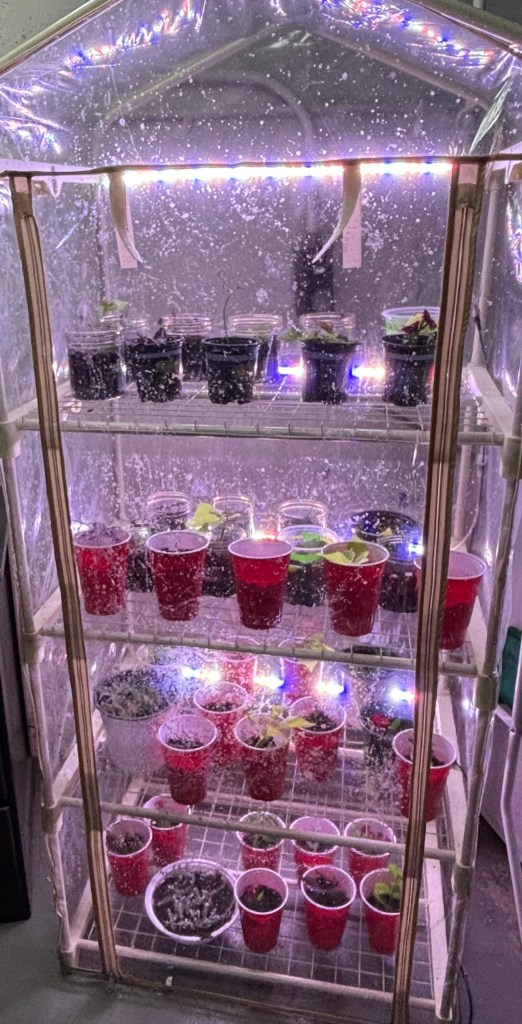
this winter we will propagate some of our summer plants. it is a new venture, introduced to us by the gift of our dear friend – a small indoor greenhouse. we will be learning what these tiny plants need, trying to help them root, keep them alive, bring them back – out of silence – to a spring in which we have a bit of a headstart.
the clearing of our house is kind of like that, too, as we move from room to room, closet to closet, drawer to drawer, bin to bin. we are still in phase one of all this, but each bit of giveaway, of throwaway, of repurposing gives air to some more space and in that space i can hear the vibrations of possibility gathering.
there are two new fuzzy white pillows in my studio on a metal strapped swivel patio chair we brought up from the basement. it feels like sitting in that chair – sinking in – could lend itself to the expression of the tacet i’ve been in, the long time of fallow. i don’t know what that means. it could just mean gaining clarity. it could mean setting it all aside. it could mean a few new notes that lead to a few new songs. the times d mentions the word “when” i counter with the word “if” because i really don’t know. there’s been a lot of pain and the wounds haven’t yet healed over. the tacet and my reticence continue.
but the potting stand reminds me: even after a period of silence, a period of fallow and nothing really happening, there is actually much in play. energy is stoking up. the time of rest is giving import to the time of sprouting. and, though this summer’s heat and humidity were incredibly generative – much like the middle years of my artist life – so will be next summer’s heat and humidity, even if the conditions are different, even if the heat and humidity are less intense. it is still a growth season.
just like now. the season has not ended with the pulling of plants from pots. negative space defines positive space, silence creates tension, the narrative of our plants continues.
it made me cry. it was all i could do not to down-and-out messy cry. had i lost control it would have been ugly. i grieved for every single american child as i struggled and hiccuped my way back to some semblance of calm. phil vassar’s lyrics were poignant and profound and deeply troubling.
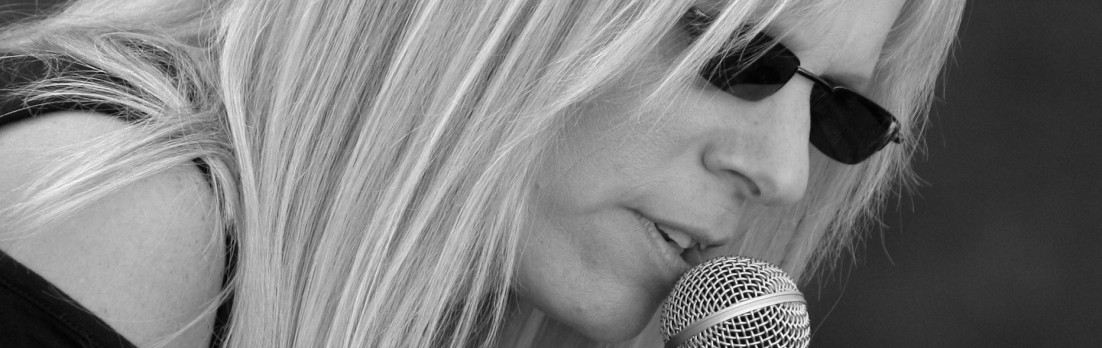
the concert was amazing. phil vassar is a prolific songwriter, a consummate performer, his voice strong, his ballads clear. i’ve seen him in concert several times and was thrilled to see him again. he is now 63 and, having had both a heart attack and a stroke, he is making his way back – to the attention of the public – for the public forgets quickly.
there are artists you hold onto, particularly when you are an artist yourself. you know when there is something absolutely special about someone – you can feel it. every song, every note, every sung lyric – this man is a master singer-songwriter. there’s nothing really fancy about him…he plays a painted acoustic yamaha piano, often standing (which i can totally relate to). his band is extraordinary and tight, the perfect backup for him.
“cause 419 lakewood had no silver spoons/just an old beat up upright that played out of tune/now i’m singing and living the life that i love/and when i count my blessings i thank god i was an american child/an american child/’cause dreams can grow wild born inside an american child.” (american child – phil vassar)
every american child.
and that’s why i cried. because it’s no longer the same. i cried for my adult children. i cried for my friends’ grandchildren. i cried for the children i don’t know. i cried for what this country has lost, the dreams that have been violently stolen, the hope that has dissolved, the democracy that hangs by tiny filaments.
at the end of the concert, phil vassar – in seemingly no hurry at all – sat on the edge of the stage and chatted with people, took selfies with his fans, signed shirts and hats and cds.
i stood at our seats and watched, both proud of him and a little bit stunned at how very gracious he was – his obvious, deep gratitude to a concert hall that should have been filled.
i knew he couldn’t hear me – and i didn’t go up to tell him – but as i stood there i whispered, “you’re relevant, phil vassar. you’re so relevant.” deep down, he already knows. he’s always been relevant.
an american child. the american dream.
“there is no trust more sacred than the one the world holds with children. there is no duty more important than ensuring that their rights are respected, that their welfare is protected, that their lives are free from fear and want and that they can grow up in peace.” (kofi annan)
“a promise once made/will it shine, will it fade/will we rise with the vision or fall?” (american child – john denver)
i couldn’t begin to guess how many times i have sat on that beach. i couldn’t begin to describe all the life i have navigated there, all the pondering i have pondered, all the sun and the snow and the rain, the early dawns, the inky skies i have shared with that place. in the mystery that connects you to certain places, it was always my go-to.
and the mystery continues.
we shared time with that beach again. profound time. time wherein i stood by the water’s edge talking to the universe. once again, feet in that sand, touching that water, eyes to that sky.
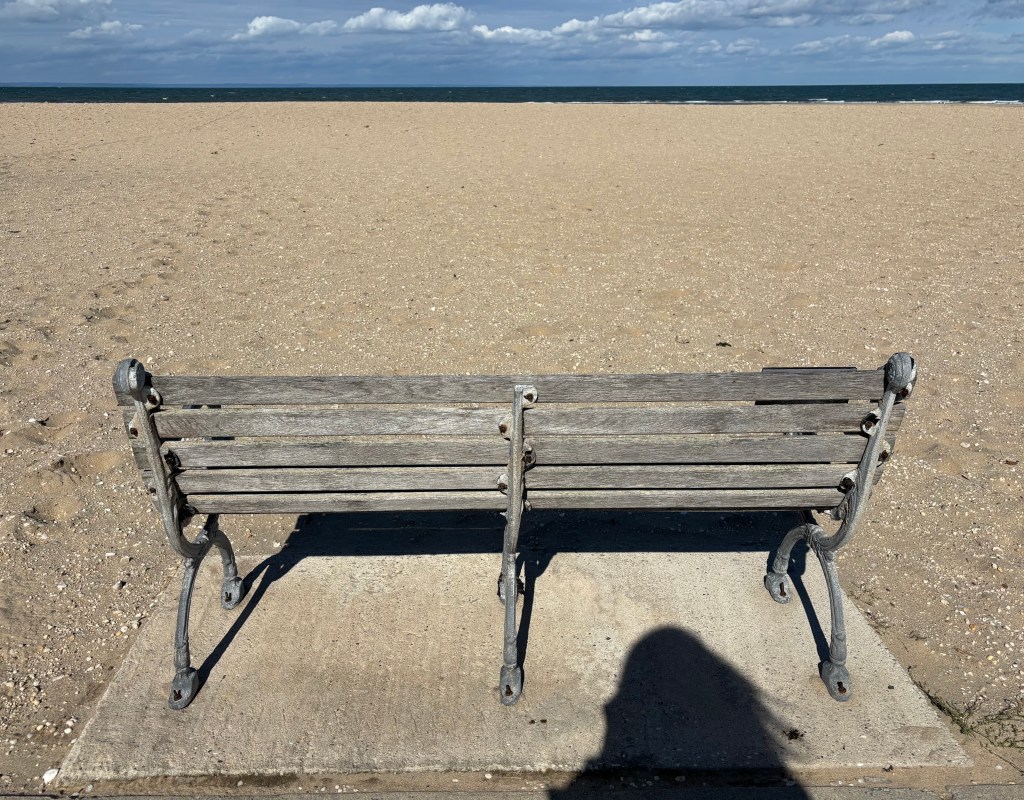
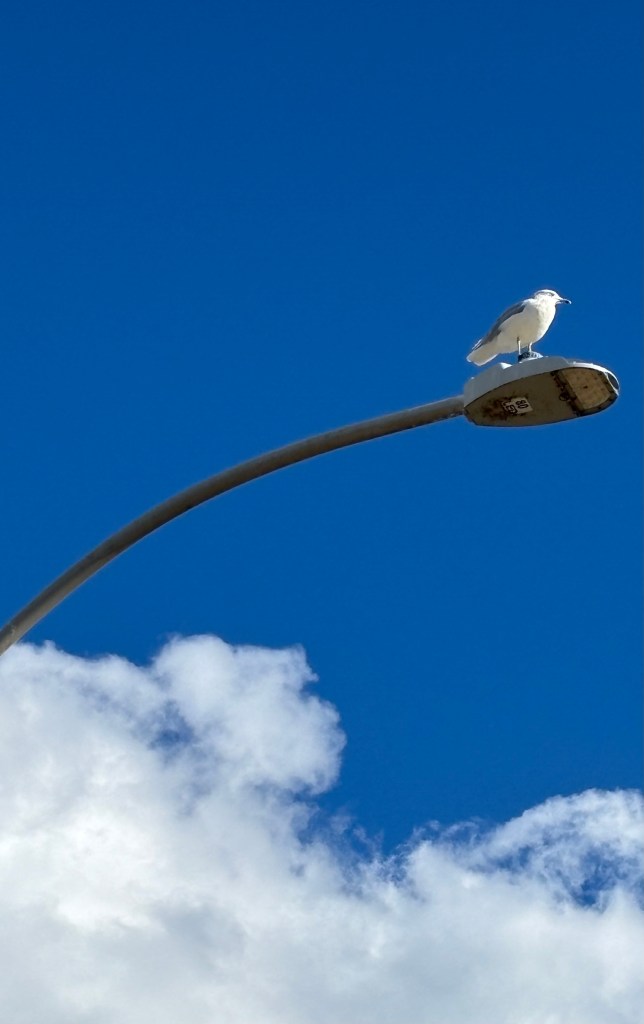
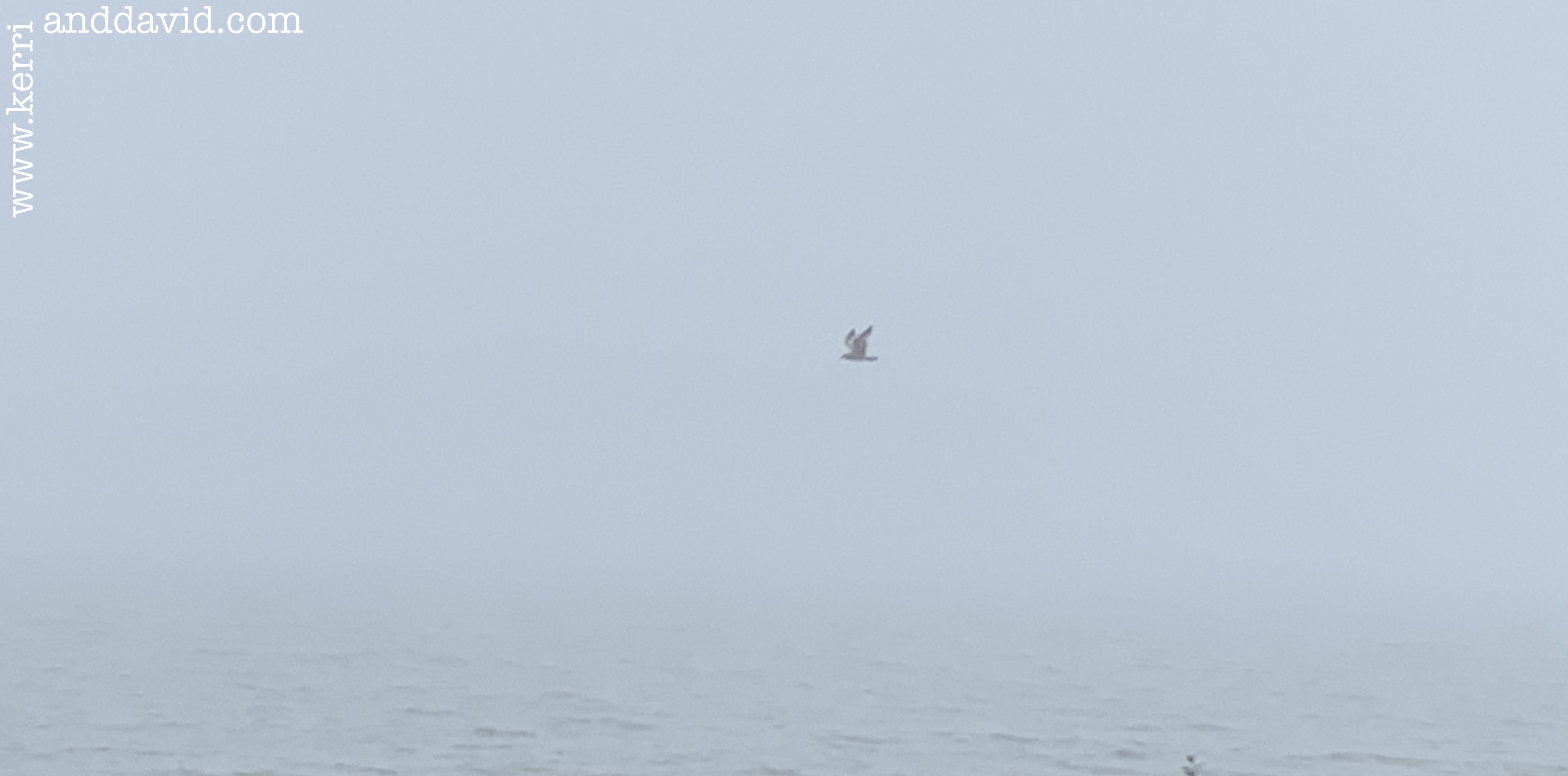
some of the benches just off the boardwalk have been there forever. the curve of the metal arm, the weather-worn wooden seat – familiar touchstones that date back and back. the seagulls diving, riding the waves, rising in air currents and dropping crabshells to the ground – their caws lodged in memory.
this is not the island’s finest. there are many beaches with less rocks, fewer shells, more shoreline, softer sand, less seaweed, stronger surf. but this is the one.
i left a piece of me – a free-to-be–crazy-with-potential–wildflower-growing piece – behind on this island.
and so i thought that maybe – just maybe – i could go put my feet on this very sand, touch this very water, drink in this very salt air to both reclaim that piece and set it free.
there was no drumroll, no hoopla, no folderol. there were no fireworks or lightning bolts.
as the wind became gusty and it got colder, i merely turned reluctantly away from the water’s edge.
he was waiting for me about halfway up the beach and he held me as i stood in that very sand under that very sun, taking it all in, grateful.
we walked arm in arm to the benches and sat on the oldest one.
“each of us is in truth an idea of the great gull, an unlimited idea of freedom,” jonathan would say in the evenings on the beach, “and precision flying is a step toward expressing our real nature. everything that limits us we have to put aside.” (jonathan livingston seagull – richard bach)
as this new school year begins i think of all the teachers and mentors i have known – those who were my teachers, my professors, my mentors, those who taught my children, friends who have been teachers, my own time spent as a teacher, instructor, director. immensely different stories, all over the spectrum.
the common denominator – to empower others to push themselves without limits, to reach their own potential, to become the best version of themselves, to fly. jonathan’s imperative.
growing up on long island meant – in the sheer sense of the word island – that i was surrounded by water. i spent a great deal of time by that water, particularly when i was able to get myself there – by bike or my little vw. i was always enchanted with the seagulls that lined our coastline, seagulls swooping and diving and soaring. the book jonathan livingston seagull was a treasured possession, kept close on the little bookshelf next to my bed. my paperback copy is waterstained and priced at only $1.50, evidence of its long tenure in my life.
even back then – on a beach towel at crab meadow beach in the mid 1970s – it was clear that the search for a life of purpose and excellence meant, also, a life of self-discovery and risk-taking. but susan polis schutz’s words “let us dance in the sun wearing wild flowers in our hair” rang for me as joyful north stars.
and so i watched and studied seagulls flying in community, flying alone. i walked the beach together with others and alone. i studied poetry with others and wrote in my tree alone. i sat on spotlit piano benches with a boom mic on old wooden stages together with others and alone.
my son recently wrote some vulnerable words. his post ended with, “…stick with it no matter what. tell your story.”
were jonathan livingston seagull around, he’d nod and think of an elder seagull’s words to him, “you will begin to touch heaven, jonathan, in the moment that you touch perfect speed. and that isn’t flying a thousand miles an hour, or a million, or flying at the speed of light. because any number is a limit, and perfection doesn’t have limits. perfect speed, my son, is being there.”
i paged through my old book. and went back to the title pages.
there in pencil i had written one of the lines i quoted above:
i have always been drawn to notebooks. composition books, spiral notebooks, journals, graph paper pads, legal pads, pa-pads – really, i guess, any kind of bound group of paper. blank paper.
it all represents a beginning. “begin anywhere,” john cage urges on a piece in my studio.
but sometimes there is a paralysis. sometimes there is something – some quirk – that stops me from starting – it stops me from putting pencil or pen to the first page. i feel this very big responsibility to the new blank paper. sometimes it feels like what i might write, compose, jot down may not be worthy of the first pristine sheet in a new paper vessel that could – ultimately – contain hundreds of writings, compositions, jottings. i haven’t yet gotten over that.
and so i dig out old spirals that my children used in elementary school – with wide rule lines – or high school – with college rule lines. their names are on the front and i can – delightedly – still find scribblings inside the notebooks. lab results or math problems, vocabulary words or drawings or paragraphs of tiny stories they were creating – it’s all thready for me and so this stack of old spirals and folders speak to my heart – in so many ways. i can easily write in these.
but there are those really delicious new books, new pads, new journals. and i glance at them, wondering when i might think that anything i might pencil in them would be worthy of their newness.
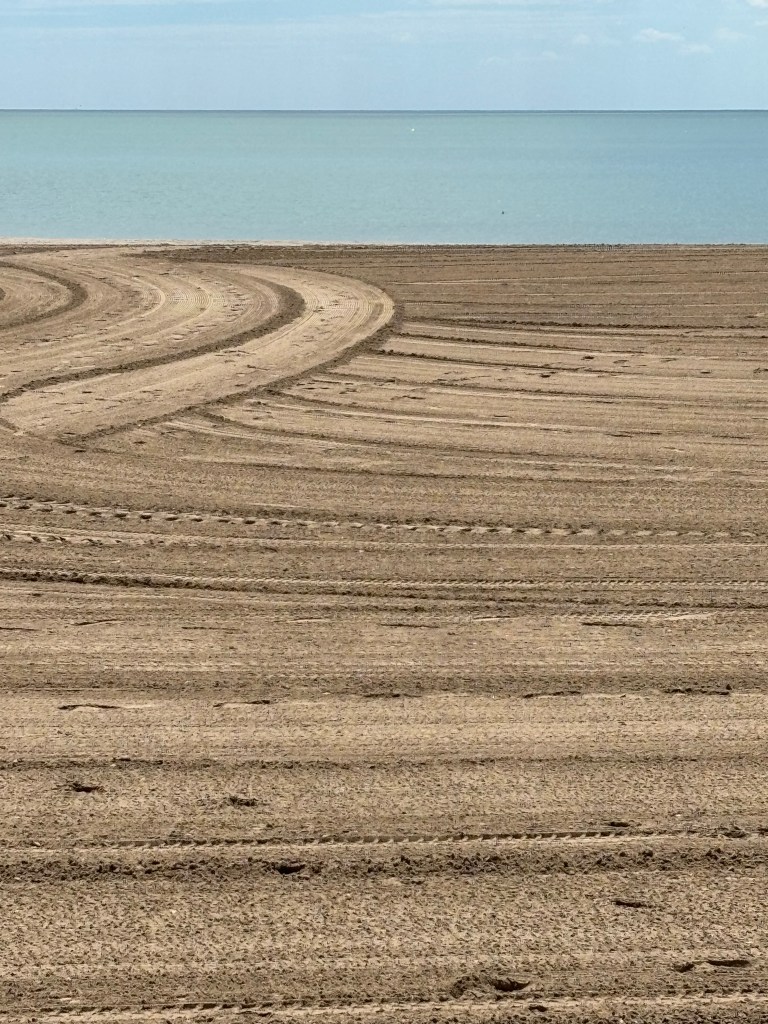
just staring at the beach was zen-full. it was quiet. almost pristine.
the beach had been combed – stunning horizontal lines – raked, perfectly clean but for a few sets of footprints walking – along the horizontal and taking the hypotenuse to the water.
the orderliness was just a tiny bit interrupted. and the orderliness was waiting for more disorderly. the disorderly would mean people – walking and running, children playing and building castles in the sand, seagulls clamming, dogs digging, sand flying.
even as i write this, i think about pulling out one of the brand new notebooks. taking my ever-present mechanical pencil to the first page (or maybe the second – to leave the first page clean and blank).
it makes me think that maybe the disorderly – the walking, running, building, digging, sand-flying – might actually be the real joy.
it makes me think i just might walk the hypotenuse across the college-ruled page. and wreak a little havoc on some clean paper.
so many clay pots and assorted planters, i drew a sketch of them all and began to list what plants and herbs and flowers we wished to grow this summer, sorting plants to pots. and we began the dreamy conversation about stepping off the deck and snipping basil or parsley, making ann’s jalapeño poppers, gazing at colorful flowers scattered on deck’s edge or along our gardens of grasses.
we are not well-versed in plants. we are most-definitely not well-versed in growing things to eat. and we truly don’t know much about different annual flowers – so we depend on the tags at the nursery and research. a few days ago we were drawn to two tiny-bloom flowers, though we didn’t know anything about them. it was a heart thing.
last fall my sister-in-law sent me two peony roots. we carefully planted them – exactly as the directions stated – making sure that the “eyes” were facing up and the root wasn’t too deep into the soil. in the miracle that is spring, peony shoots have risen from the ground – and you would think we’ve given birth – our wonder, our level of excitement are off the charts. it is a joy to think of these new beauties – with gorgeous big white blooms – growing alongside two established peonies, many ornamental grasses, wild geranium, day lilies, hosta, and healthy weeds of many varieties.
we have much to learn…about all of it.
gardening, we see, is like the joys of being an artist. experimentation and not being able to determine an outcome ahead of time – both are important in the process. we give over to the mystery of it all. we know that it all is steeped in potential and we embrace it. it’s a giant responsibility – a gift of nurture we can give – to our artistry, to our garden.
it would be an easy segue to connect the dots of this kind of potential – this kind of responsibility – to the governing of this country. it would be easy to speak of the glorious mystery of our melting pot, the growth that is possible in the garden of humanity. it would be simple to believe that there should be wonder and great excitement in nurturing all the people of this country – whether or not they are different than those we know well – learning and growing together. it would be natural to depend on research and heart in moving forward all that we – in these United States – can be.
but no. i won’t go there. it all just seems so obvious.
a country – a first-world democracy exuding potential beyond belief.
why wouldn’t you tend that garden with great care and embracing respect and intelligent research and nurturing love?
why would you wish to crush or annihilate or suppress or obliterate all that potential?
stripe, the caterpillar, after eating many leaves and crawling many crawls, was driven to climb a pillar of caterpillars he could see that stretched way, way high up into the clouds. it seemed an imperative – the thing every other caterpillar was doing. without question, he began to climb, stepping on other caterpillars in his zeal to get to the top of the pillar. he couldn’t see what was up there and he did not know where they were all going. he begins to wonder aloud. yellow, another caterpillar close by, agrees that she was also wondering, but that “no one else seems to worry about where we’re going so it must be good.” stripe needs to keep going and so he steps on yellow who is in his way in the caterpillar pillar, stating, “well, i guess it’s you or me.” he then crawls off and apologizes to her.
stripe and yellow continue climbing the pillar. but stripe is feeling bad and wonders, “how can i step on someone i’ve just talked to?” together – realizing that the pillar made no sense – they decide to climb off the caterpillar pillar and make a peaceful life together crawling and nibbling grass.
after a bit of time, it seemed that crawling and nibbling grass and hugging each other in a caterpillar sort of way was not quite enough, that there was more to life. stripe felt the call of the pillar once again and, leaving a reluctant yellow behind, went back to climb high, high, high with all the other lonely climbing caterpillars that had no idea of what was at the top.
yellow, desolate without stripe, wandered away from their home. she came upon a caterpillar spinning a cocoon and it spoke to her, telling her it was doing what was necessary to become a beautiful butterfly. it told her that “without butterflies, the world would soon have few flowers.”
yellow could not believe that there was a butterfly inside of her, but the cocoon explained to her that she had to wish to fly with beautiful wings so much she need give up being a caterpillar. it explained that “life is changed, not taken away.” it explained that a cocoon is “an in-between house where the change takes place” and though “it will seem to anyone who might peek that nothing is happening…the butterfly is already becoming. it just takes time.”
and then it tells yellow that “once you are a butterfly, you can really love – the kind of love that makes new life.”
yellow chooses to spin a cocoon.
stripe – on the caterpillar pillar – determined to get to the top – watches the caterpillars squished at the top falling off to their deaths far below. he is ruthless, with the words “don’t blame me if you don’t succeed! it’s a tough life” at his lips for any caterpillar on the pillar who would complain.nearing the top he felt the pressure of the other caterpillars jammed in around him.
one day a beautiful yellow butterfly with eyes filled of love flew near him. “looking into the creature’s eyes he could hardly bear the love he saw there. he wanted to change, to make up for all the time he had refused to look at the other…the others stared at him as though he were mad.” and stripe realized that to get to the top he needed to fly, not climb, delighted to believe this possibility – that there was a butterfly inside of him.
stripe began to carefully descend the caterpillar pillar, looking each caterpillar in the eyes and whispering, “i’ve been up; there’s nothing there.” other caterpillars were shocked, refusing to listen, dedicated to blindly climbing. one asked, “don’t say it even if it’s true. what else can we do?” stripe answered, “we can fly! we can become butterflies! there’s nothing at the top and it doesn’t matter!”
the other caterpillars were not as convinced and it was a struggle to get down off the pillar. one “crawler sneered, ‘how could you swallow such a story? our life is earth and climbing. look at us worms! we couldn’t be butterflies inside. make the best of it and enjoy caterpillar living!”
stripe made his way to the bottom, exhausted, falling asleep.
and just as in every good story – yellow, the butterfly, flew to him and – with great love – helped him to spin his own cocoon and then waited. until one day stripe emerged as a beautiful butterfly, able to fly to the heavens and bring love to the flowers. 💛
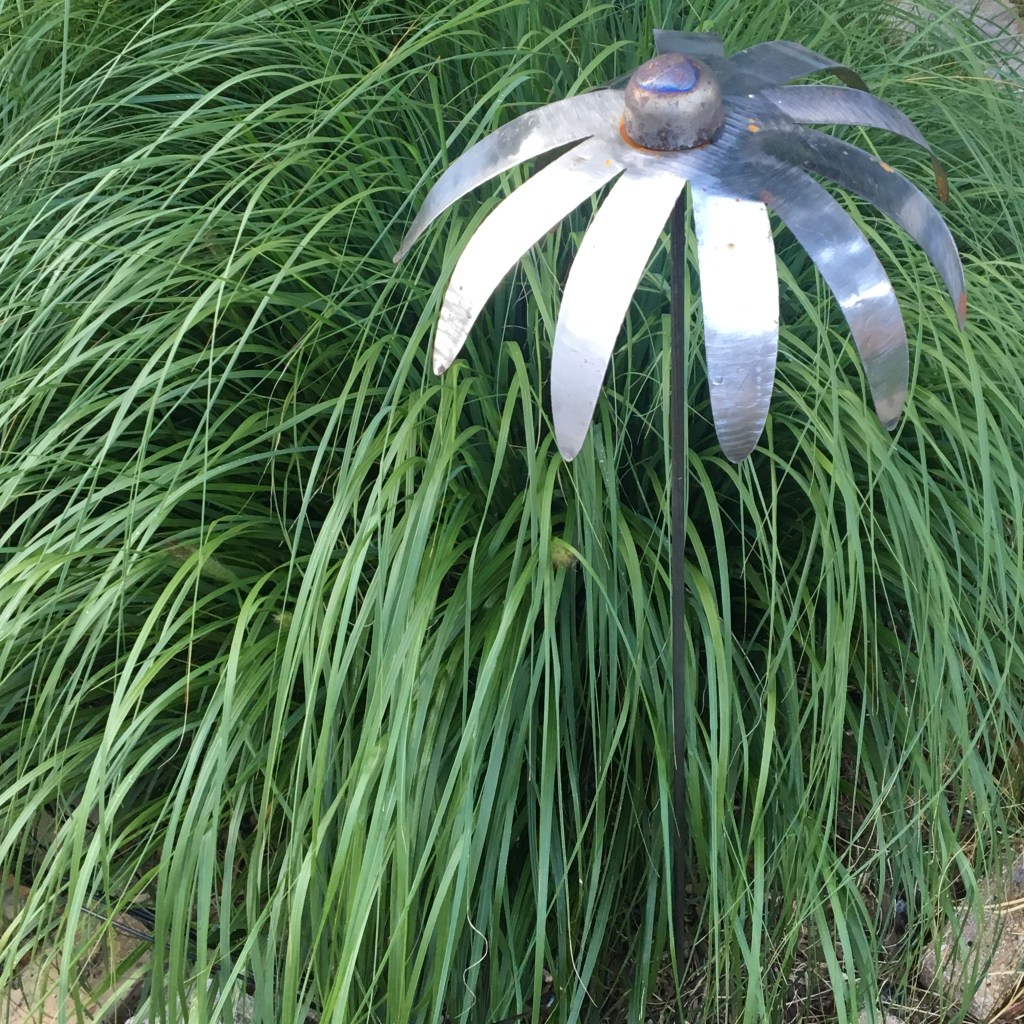
the simple metal coneflower sculpture outside in the garden of the shop in the tiny town of stockholm on the river road invited me to walk to it. soldered slightly askew, it was the perfect flower for our ornamental grass garden right in the middle of our backyard, right next to the old bricks from the standing basketball hoop, right next to breck, our aspen tree. a permanent flower.
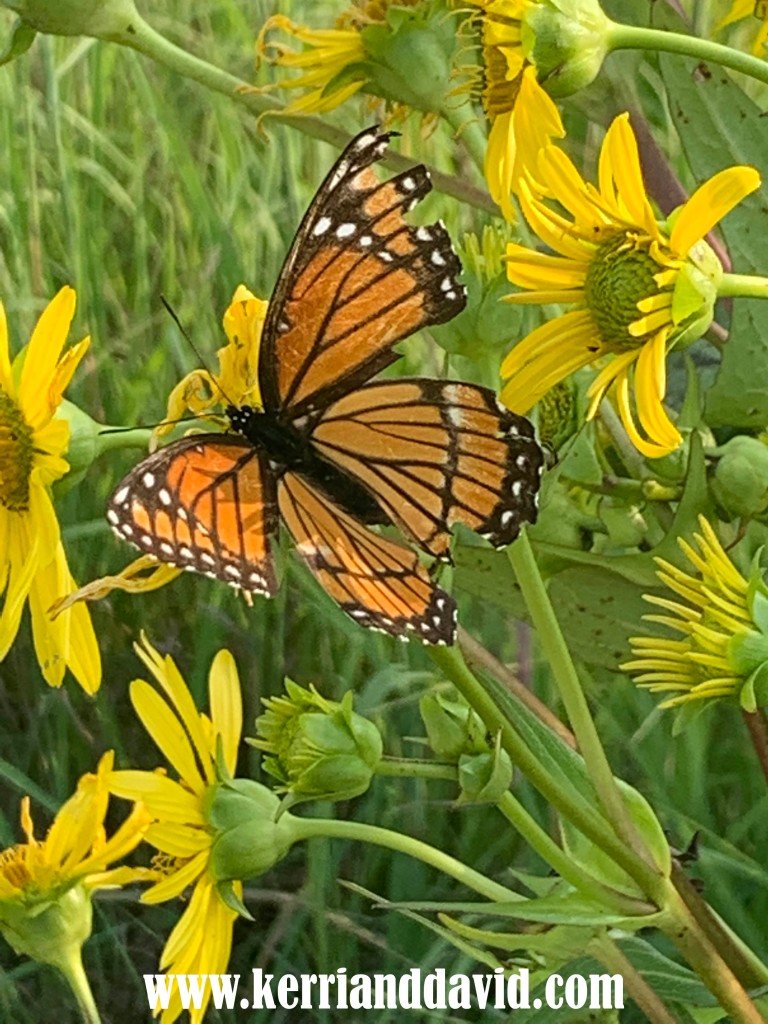
i could not help but think of this little book as i looked at this photograph. published in 1972, it is completely relevant in today’s world.
if you need a visual for kamala harris that is different than all the joy and positivity she is already offering our country, you might think of this story. she is a butterfly.
it is without a doubt the maga party is the caterpillar pillar, full of ruthless pillar climbers, of crushing pressure and no compassion, of nowhere to go, of no one asking questions, of no love.
it’s a clear choice, worthy of thoughtful consideration.
i choose the butterfly life, just like stripe and yellow.
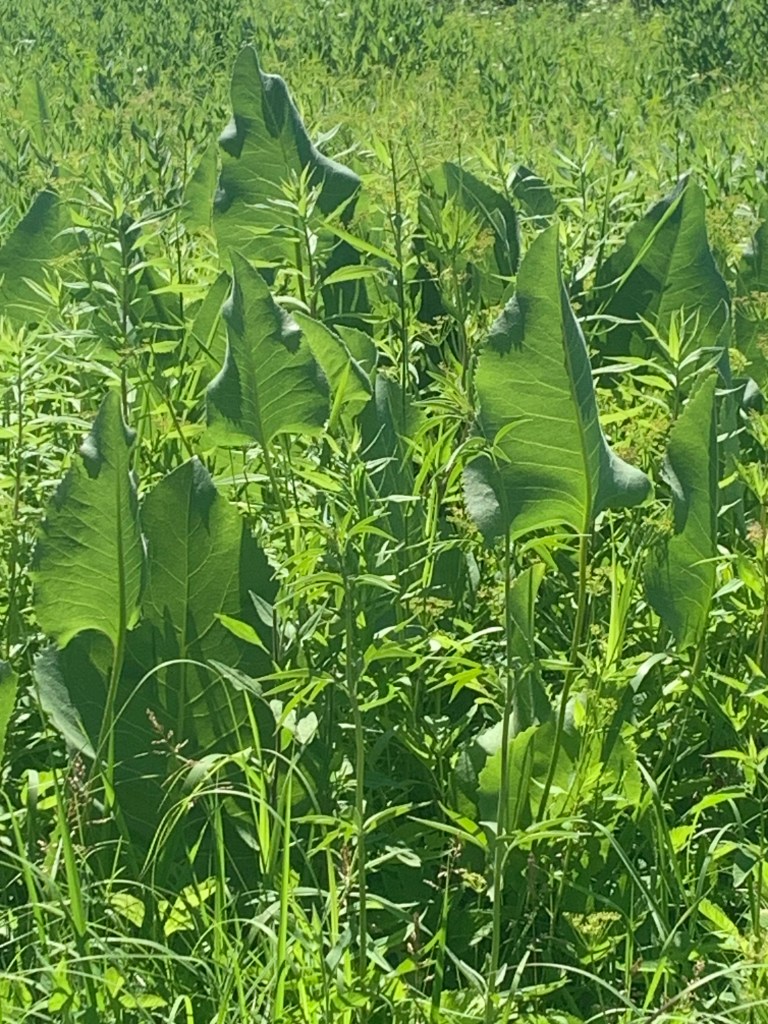
it’s merely nuance. just the subtlety of shades, leaves begging for us to notice.
surrounded by meadows filled with wildflowers and a splendid array of color, these leaves are blend-inners, standing out only by their presence in size. so beautiful.
it’s like people, sort of. there are blend-inners and there are stand-outers. both are necessary in the balance of the meadow or the prairie.
the stand-outers are noisier, more assertive – colorful and obviously there, attracting attention, striding.
the blend-inners camouflage into the surroundings, quietly supporting efforts of others, tenaciously pursuing their own bliss, no wish to be flamboyant or noticed.
the surprising thing, however, is when – like this prairie dock plant – there is suddenly growth that is astounding. flower stems begin to shoot up skyward.
if you only passed by in early june you would not know this. you would assume that these broad leaves were in monochromatic zen with the rest of the meadow. you would assume that they would silently simply green their way through the season, other wildflowers growing up and around them, perhaps stifling them.
you would not know that later – just a little bit of time later – these seeming blend-inners would herald tall leafless stems – even as high as eight feet tall – sporting bright yellow daisy-like flowers. it becomes a towering plant, high above the rest, hardy and pretty much invincible. not so silent anymore.
you just can’t judge a book by its cover, can you?
looking like a new year’s eve party noisemaker waiting to unfurl in celebration, the fern steadily grows. in-between last year’s clipped stalks and in and among dried leaves and the last vestiges of winter’s effect on mulch, it peeks out, pushing up toward the sun. it chooses to thrive, even covered by sandy soil and bits of the past. one day soon i will walk out to the back – where the fern garden is – and this tiny fern will have stretched and straightened and fanned out into a lanky beautiful feather.
it makes me think about blowout noisemakers. all furled up they look relatively innocuous and not particularly capable of being noisy. a little gumption and air blown into them and they can be pretty doggone loud.
the little fern breathes deep and reaches down into where gumption is stored. against the odds, this seemingly fragile, willowy plant rises up, centimeter by centimeter. suddenly it is a powerhouse, standing tall in the rain and a part of the wind in storms.
though it may be all trembly inside as it makes its journey upward and outward, its gumption, air and the sun give it courage and strength. it is tough and resilient and – it is said – has an incredibly strong survival instinct.
how often we are all tiny ferns – over and over – through fallow and rejuvenation, covered in the patina of the past and growing it off. innocuous and silent.
it is full of seeds, full of possibility, full of tomorrows.
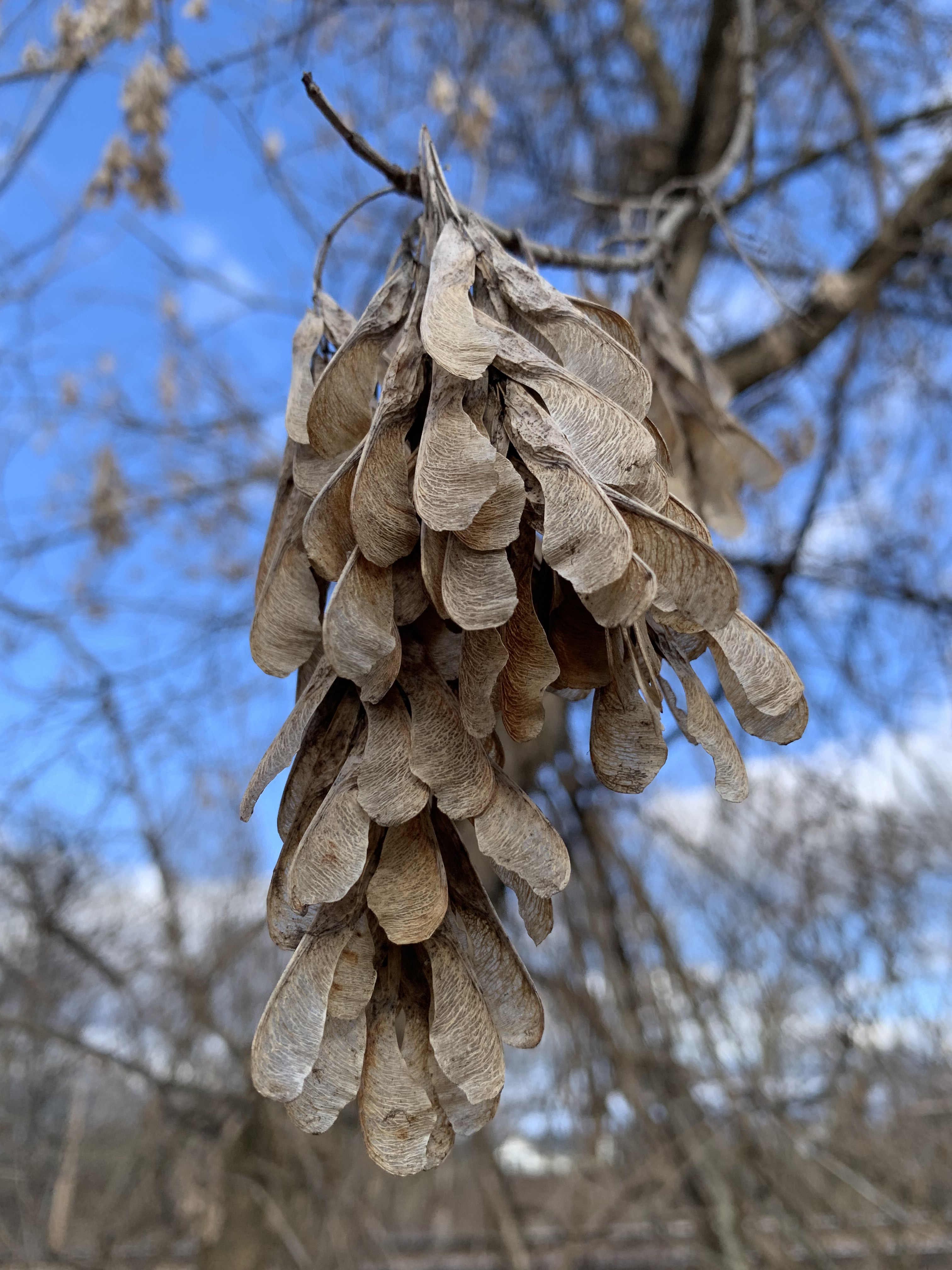
and it will all spin and float and whirligig – just like these maple seedpods.
though wrinklier now than in last spring or last summer – and, really, ever more wrinkly – these samaras are ever viable and will coax saplings from the ground once they disperse. with big breezes at their backs, the winds of change, the tug of relevance, in fields of gold and forests of native plants. though they have been dormant, though they haven’t germinated for months or even years, they remain alive.
alive.
resilient.
for placing samaras in a bowl of water, it is the seedpods that sink that have seeds likely to germinate. the others – the ones floating – are less likely, though sometimes it simply takes a little soak in warm water, a little good soil and a continued cold blast of air for some time – a bit of fallow – that will draw out the remaining life.
it’s funny. you’d think that the test for a maple seed would be it if floats in water – floating – the ability to rise above that which wishes to drown you. but the real test – for the likely viability of a maple seed – is to hope that it sinks. clearly, maple seeds hold their breath.
and then, the seeds breathe. out of the bottom of the bowl in which they have sunk. and the seeds sprout. even from the trauma they have endured, the inertia they have tolerated. and the seeds grow big strong maple trees, even though buckthorn and other toxic invasives would prefer them stifled. the maples withstand, persist, ride it all out.
so – for those of you out there who are thinking 65 is run-roughshod-over, washed-up, put-out-to-pasture, tested by toxins, no-longer-relevant, done – i have some news.
some good news.
it is the steadfastness of a drowned seedpod.
or, in the case of a wrinkled-up-old-floater, just a little warm water, a little good soil, a little cold fallow and then, a little sun.











 reverse threading